Researchers develop ultrafast oscilloscope on a chip
(PhysOrg.com) -- As photonics -- using beams of light in place of electricity for communications and computing -- becomes more common, engineers need new tools for troubleshooting. Now researchers at Cornell have created a way to plot the waveform of an ultrashort-lived optical signal with a resolution of less than a trillionth of a second.
Several current methods can measure such brief waveforms by averaging many repeating events, but the new method -- using an "ultrafast optical oscilloscope" -- can catch those frustrating events that happen only once in a while, the Cornell researchers said.
"We can make measurements of very short optical phenomena. The signal can be very weak, and it doesn't have to be repetitive," said Alexander Gaeta, Cornell professor of applied and engineering physics. Applications include analyzing intermittent glitches in fiber-optic communications and observing such fast-moving events as chemical reactions or laser fusion, he said.
The device is described in the Nov. 6 issue of the journal Nature (455: 7218) by Gaeta and colleagues including Michal Lipson, associate professor of electrical and computer engineering, and postdoctoral researcher Mark Foster.
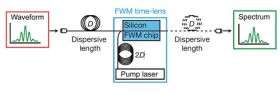
The innovation converts "time to frequency" using a process called four-wave mixing, in which two beams of light, referred to as the signal and the pump, are combined in a narrow channel -- in this case a silicon waveguide on a chip, 300-by-750 nanometers in cross section. The narrow space forces the two beams to exchange energy, and a copy of the signal at a new wavelength emerges. The wavelength of the copy depends on the wavelength of the pump, and for this application the wavelength of the pump changes linearly in time.
The pump pulse is generated by a laser that outputs a broad band of wavelengths, and sent through a 50-meter length of optical fiber. Each wavelength of light travels at a slightly different speed in the fiber, so the pump pulse stretches into a stream in which wavelength varies continuously over time. In the four-wave mixing chip the stream is combined with the waveform to be analyzed, which varies in intensity over time. What emerges is a pulse in which each tiny moment of the input waveform is represented by a different wavelength of light, and the intensity, or brightness, of the light at that wavelength corresponds to the intensity of the input wave at that moment.
The result is fed into a spectrometer, which produces a graph of the intensity of light at each wavelength, and that graph corresponds to the original temporal waveform.
Lipson's research group is developing a dispersive waveguide on a chip that will replace the 50 meters of fiber, as well as a spectrometer on a chip, Gaeta said, so that the entire device eventually can be fabricated on a single chip.
The work is supported by the Defense Advanced Research Projects Agency, the National Science Foundation and the New York Office of Science, Technology and Academic Research.
Provided by Cornell University


