Protect your vote -- avoid election machine errors
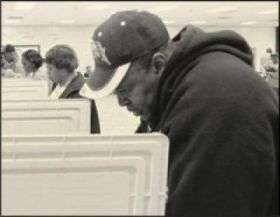
Of all the conceivable problems that could lead to a miscount Election Day, there's one possibility that voters can do something about – avoid making election machine-related errors, says a University of Maryland researcher who led a comprehensive study of voter problems using touch screen and paper-based machines.
"Under the best of circumstances, simple voter mistakes can make the difference in a close election, so it's up to individuals to go into the booth prepared and aware of the pitfalls," says Paul S. Herrnson, the University of Maryland political scientist who led a multi-year, multi-state study comparing voter use of electronic and paper/optical scan systems. The research team included political scientists, computer scientists and psychologists.
"In our experiments, even with the simplest ballot design and the most user-friendly machines, we found voters still cast their ballots for the wrong candidate about three percent of the time," Herrnson adds. "Depending on which polls you believe, that's enough of a margin to affect the outcome on Tuesday. Most often, when voters make a mistake, they not only fail to cast their ballot for the candidate they want, they end up voting for the opponent. So it's a double whammy."
Here are some common problems that showed up in the Herrnson team's research, "Voting Technology: The Not-so-Simple Act of Casting a Ballot":
-- Most voter errors involve choosing a candidate whose name is listed immediately before or after the one the voter intended to select.
-- Voters casting ballots on touch screen systems are likely to make somewhat fewer errors than those using paper ballot/optical scan systems or the dial-and-buttons systems.
-- A common problem with paper ballot/optical scan systems involves write-in votes, where voters often fail to fill in the oval alerting the machine to look for a write-in. This error voided the write-in effort 30 percent of the time in the study.
Herrnson recommends that voters take the following precautions to minimize the chance of errors:
-- Bring a marked-up sample ballot to the polling place. This will enable voters to quickly and accurately transfer the information from the sample ballot to the real thing, saving time and cutting down the likelihood of errors due to snap decisions.
-- Voters using touch screen or other electronic voting systems should pay careful attention to the review screen. The screen will highlight any races or ballot questions where the voter has not made a selection or has marked the ballot incorrectly.
-- Voters using touch screen systems can and should compare the review screen to the sample ballot they brought with them.
-- Voters using paper ballot/optical scan systems will have to be more vigilant. These systems don't have review pages that highlight skipped or missing votes. Some vote scanners do have a small screen that alerts voters who did not make a selection in a specific race or who made more selections than allowed in a given race. (It is impossible to make the latter "overvote" error on electronic systems.)
-- Once voters realize they've forgotten to make a selection on a paper ballot, the remedy is simply to fill in the oval and make the choice. But, the remedy for a wrong selection is to start over with a new paper ballot and discard the old one. Voters who cross out one choice and fill in the oval for another are likely to have that vote nullified because the scanner will treat them as two votes in a single race, an overvote.
-- If voting on paper and casting a write-in vote, be sure to fill in the oval, complete the arrow, or do whatever is required to alert the machine that a write-in selection has been made.
As for long-term solutions, Herrnson recommends greater care in the design and preparation of the ballots by election officials and increased education efforts to make sure voters are familiar with the machines and the ballot before they go to cast their votes.
Source: University of Maryland


