Preventing forest fires with tree power: Sensor system runs on electricity generated by trees
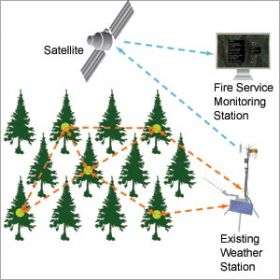
(PhysOrg.com) -- MIT researchers and colleagues are working to find out whether energy from trees can power a network of sensors to prevent spreading forest fires. What they learn also could raise the possibility of using trees as silent sentinels along the nation's borders to detect potential threats such as smuggled radioactive materials.
The U.S. Forest Service currently predicts and tracks fires with a variety of tools, including remote automated weather stations. But these stations are expensive and sparsely distributed. Additional sensors could save trees by providing better local climate data to be used in fire prediction models and earlier alerts. However, manually recharging or replacing batteries at often very hard-to-reach locations makes this impractical and costly.
The new sensor system seeks to avoid this problem by tapping into trees as a self-sustaining power supply. Each sensor is equipped with an off-the-shelf battery that can be slowly recharged using electricity generated by the tree. A single tree doesn't generate a lot of power, but over time the “trickle charge” adds up, “just like a dripping faucet can fill a bucket over time,” said Shuguang Zhang, one of the researchers on the project and the associate director of MIT's Center for Biomedical Engineering (CBE).
The system produces enough electricity to allow the temperature and humidity sensors to wirelessly transmit signals four times a day, or immediately if there's a fire. Each signal hops from one sensor to another, until it reaches an existing weather station that beams the data by satellite to a forestry command center in Boise, Idaho.
Scientists have long known that trees can produce extremely small amounts of electricity. But no one knew exactly how the energy was produced or how to take advantage of the power.
In a recent issue of the Public Library of Science ONE, Zhang and MIT colleagues report the answer. “It's really a fairly simple phenomenon: An imbalance in pH between a tree and the soil it grows in,” said Andreas Mershin, a postdoctoral associate at the CBE." The first author of the paper is Christopher J. Love, an MIT senior in chemistry who has been working on the project since his freshman year.
To solve the puzzle of where the voltage comes from, the team had to test a number of theories - many of them exotic. That meant a slew of experiments that showed, among other things, that the electricity was not due to a simple electrochemical redox reaction (the type that powers the 'potato batteries' common in high school science labs, en.wikipedia.org/wiki/Lemon_battery). The team also ruled out the source as due to coupling to underground power lines, radio waves or other electromagnetic interference.
Testing of the wireless sensor network, which is being developed by Voltree Power (voltreepower.com), is slated to begin in the spring on a 10-acre plot of land provided by the Forest Service.
According to Love, who with Mershin has a financial interest in Voltree, the bioenergy harvester battery charger module and sensors are ready. “We expect that we'll need to instrument four trees per acre,” he said, noting that the system is designed for easy installation by unskilled workers.
“Right now we're finalizing exactly how the wireless sensor network will be configured to use the minimum amount of power,” he concluded.
The original experiments were funded by MagCap Engineering, LLC, through MIT's Undergraduate Research Opportunities Program.
Provided by MIT


