I can't believe it's not fried: New oven fries food without oil
Sep 16, 2008
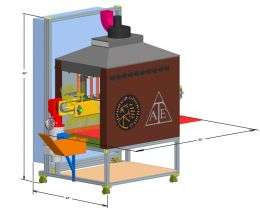
The radiant fryer, invented by Purdue food scientist Kevin Keener, is designed to quickly produce foods that appear and taste like they have been fried, except without using any additional oil. Engineers from partner Anderson Tool and Engineering Co. just completed this design and, in cooperation with Keener, plan to build a commercial prototype of the oven by the end of the year. (Anderson Tool image/Kevin Judd)

(PhysOrg.com) -- A new type of oven quickly produces foods that appear and taste identical to those that were fried, but, unlike traditional fryers, uses no additional oil. The "radiant fryer" could create products with 50 percent less oil, less fat and fewer calories than conventional fryers, said Purdue University food scientist and inventor Kevin Keener.

"The radiant oven has the capacity to replicate the frying process without placing the food in an oil bath," said Keener, an associate professor. "If we're successful, when you put the product from our oven next to one that's been traditionally fried, you won't be able to tell the difference."

Keener partnered with the Indiana-based Anderson Tool and Engineering Co. to produce a commercial prototype. The company recently completed a computer design of the oven and has begun to assemble some of its parts, said company president Ted Fiock. The team plans to have the oven built and working by the end of the year, he said.

The oven, which the team also refers to as a radiant fryer, works by emitting wavelengths of radiant energy to precisely cook food products. It may, for example, heat the inside of a food without cooking its exterior, Keener said. Because of this precision, the system requires specific instructions on how to cook each item. This makes it ideal for cooking preformed, similarly-shaped products like potato chips, chicken nuggets or fish sticks – or anything square, round or boot-shaped, he said.

"If we precisely control a product's size and shape, we can produce the same thing every time, like a perfectly browned, round chicken patty," Keener said.

This uniformity allows the oven to be quite speedy: one could churn out 300 dozen donuts per hour, Keener estimated. It also rapidly reheats refrigerated or frozen products, he said.

"If it works like we hope, we could take donuts from the freezer to the countertop – hot and ready to eat – within two minutes," Fiock said. "Currently, this is all but impossible."

The oven would most likely cook foods that have already been partially fried, or par-fried. Such products are traditionally fried at a central food manufacturer before being chilled or frozen and shipped to restaurants and retail outlets, where they're often refried before serving, Keener said.

"Many people don't realize that your typical French fry has been fried twice," Keener said.

If the prototype passes a series of tests later this year, the team hopes to commercialize the oven, Fiock said.

"All of these things we envision cooking with the oven are products the food industry would like to find out how to design with less fat," Keener said. "This might be one way."

Another benefit to the oven is that it would eliminate the use of hot oil, which is hazardous to discard, presents a fire risk and can burn workers if spattered or spilled, possibly causing serious injury, Fiock said.

Keener and Brian Farkas, a food scientist at North Carolina State University, are co-inventors of the patent-pending oven design. They completed a smaller prototype – about the size of a standard microwave oven – upon which many of the calculations for the commercial prototype are based, Keener said. Food from this first prototype proved indistinguishable from emergent-fried products to a panel of taste-testers, he said.

Provided by Purdue University

Explore further: Taking stock of technology

add to favorites email to friend print save as pdf

Related Stories

Snowden's life surrounded by spycraft

3 hours ago

In the suburbs edged by woods midway between Baltimore and the U.S. capital, residents long joked that the government spy shop next door was so ultra-secretive its initials stood for "No Such Agency." But ...

Winners and losers at this week's E3

3 hours ago

Since the first battles over "Pong" machines in local arcades four decades ago, video gamers have loved good competition. And this year's Electronic Entertainment Expo—the industry's largest annual gathering—presented ...

Europe's space truck docks with ISS

3 hours ago

A robot freighter bearing 6.6 tonnes of cargo docked with the International Space Station (ISS) on Saturday, the European Space Agency (ESA) said.

Secret to Prism program: Even bigger data seizure

3 hours ago

In the months and early years after the Sept. 11, 2001, terrorist attacks, FBI agents began showing up at Microsoft Corp. more frequently than before, armed with court orders demanding information on customers.

Recommended for you

The broken symphony of swinging metronomes

1 hour ago

An experiment with 30 metronomes reveals chimera states which combine aspects of synchrony and of disorder. Researchers had been looking for such states for ten years.

Wooden beam could be detached part of shipwreck

1 hour ago

A wooden beam that has long been the focus of the search for a 17th century shipwreck in northern Lake Michigan was not attached to a buried vessel as searchers had suspected, but still may have come from the elusive Griffin ...

Prehistoric rock art maps cosmological belief

8 hours ago

It is likely some of the most widespread and oldest art in the United States. Pieces of rock art dot the Appalachian Mountains, and research by University of Tennessee, Knoxville, anthropology professor Jan ...

'Ugly' finding: Unattractive workers suffer more

10 hours ago

People who are considered unattractive are more likely to be belittled and bullied in the workplace, according to a first-of-its-kind study led by a Michigan State University business scholar.

Taking stock of technology

11 hours ago

At the recent Harvard IT Summit, Anne Margulies, vice president and University chief information officer, mentioned how Harvard had been at the forefront of information technology since its inception, even to the point of ...

User comments : 2

Adjust slider to filter visible comments by rank

Display comments: newest first

kerry
not rated yet Sep 17, 2008
"This uniformity allows the oven to be quite speedy: one could churn out 300 dozen donuts per hour, Keener estimated. It also rapidly reheats refrigerated or frozen products, he said."

=D this is amazing!
Valentiinro
not rated yet Sep 17, 2008
Aw man. This isn't something one could use at home to fry fish then. I saw the headline and thought "I want one". But unless I programmed good instructions and cut a fish the exact same way every time it would not work for me even if they were selling them to individuals, which they probably wont.

More news stories

The broken symphony of swinging metronomes

An experiment with 30 metronomes reveals chimera states which combine aspects of synchrony and of disorder. Researchers had been looking for such states for ten years.

Wooden beam could be detached part of shipwreck

A wooden beam that has long been the focus of the search for a 17th century shipwreck in northern Lake Michigan was not attached to a buried vessel as searchers had suspected, but still may have come from the elusive Griffin ...

Prehistoric rock art maps cosmological belief

It is likely some of the most widespread and oldest art in the United States. Pieces of rock art dot the Appalachian Mountains, and research by University of Tennessee, Knoxville, anthropology professor Jan ...

Gay marriage ruling unlikely to cause anti-gay backlash

Concerns that a U.S. Supreme Court ruling favorable to gay marriage might produce a backlash that would impede efforts to achieve equality are unfounded, according to a study by researchers at University of California campuses ...