LGE develops a PDP module with the world's highest brightness and contrast ratio
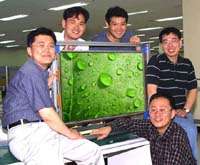
LGE has successfully developed a Plasma Display Panel (PDP) that boasts the world’s highest brightness at 1500 candela (1.5-2 times the industry's average) and contrast ratio of 5000:1, thus demonstrating again its exclusive technological superiority in the PDP industry.
LGE's PDP Development Team displaying a PDP module with the world's highest brightness and contrast ratio
- Demonstrates its technological superiority with the industry's best picture quality at 1.5-2 times the average brightness
- Another technological breakthrough following its development of the world's first K/K module
- Will vigorously commercialize the product and apply it to all its models in the first half of this year
- Aims for the world's top spot with 30% market share by 2005
LG Electronics Inc. has developed a PDP module with the world’s highest brightness and contrast ratio.
LGE (CEO: S.S. Kim/www.lge.com) has successfully developed a PDP that boasts the world’s highest brightness at 1500 candela (1.5-2 times the industry's average) and contrast ratio of 5000:1, thus demonstrating again its exclusive technological superiority in the PDP industry.
To implement the world's highest brightness and contrast ratio, LGE formed a 20-member research team including five doctoral holders to develop the following technology over the last year with an investment of 3.5 billion won.
▲ Peak enhanced technology (PET) needed to implement high brightness
▲ Technology enabling a high contrast ratio by implementing 'real black'
▲ New ASIC technology
▲ Algorithm to improve picture quality
Also, in March during CeBit 2004, the world's largest fair in multimedia electronics and information, held in Hanover, Germany, LGE unveiled a 42-inch PDP that features a brightness of 1,500:1 and a contrast ratio of 5,000:1, receiving much acclaim from buyers and viewers.
LGE, in 2003, became the world’s first to develop the K/K PDP module with brightness of 1000cd/㎡ and contrast ratio of 1000:1, and is currently applying a contrast ratio of 3000:1 to all its models.
LGE is set to commercialize the PDP with the world's highest brightness and contrast ratio in the first half of this year, and will apply it to all its models within this year.
Kim Han-soo, Vice President of LGE's PDP division said, "LGE will gain a 30% share in the global PDP market by 2005, thus consolidating the world's top spot, by securing notch-ahead advanced PDP design and process technologies and the world's largest PDP production capacity."
LGE, in 1998, surpassed the front-running Japanese PDP makers by developing the world’s first 60-inch PDP, and went on to develop the world's largest 71-inch and 76-inch PDPs in 2003 through continuous R&D investments. This time, LGE has come up with a PDP with the world's highest brightness and contrast ratio that enables brilliant picture quality, demonstrating again the world’s top PDP technological superiority.
[LGE’s PDP Investments and Development Achievements]
1. PDP Business and Strategy
A. PDP Business Status
I. History
- 1993: Began to develop PDPs
- 1996: Installed a pilot line
- 1997: Developed a 40-inch PDP
- 1998: Developed a 50-inch PDP and the world’s first 60-inch PDP
- 1999: Began to sell 40-inch PDP TVs
- 2001: Began operating PDP A1 (line 1) in March (a monthly
capacity of 30,000 units)
- 2003
A. Began operating PDP line 2 in July (a monthly capacity of 35,000 units) B. Developed 71- and 76-inch PDPs and K/K PDPs C. Forged a PDP R&D alliance with Thomson
- 2004
A. April 2004: Constructed a PDP module plant with an annual capacity of 240,000 units in Nanjing, China B. April 2004: Began operating PDP A2 (line 3) with a monthly capacity of 100,000 units C. May 2004: Commenced the first phase of the PDP A3 (line 4) plant with a monthly capacity of 120,000 units with operations scheduled for the second quarter of 2005 D. Developed PDP modules with the world’s highest brightness (1.5K) and contrast ratio (5K) in May 2004
II. Investment Status and Plans
- PDP A1 (line 1) (30,000 units monthly): KRW200 billion
- PDP A1 (line 2) (35,000 units monthly): KRW135 billion
- PDP module plant (LGENP) in Nanjing, China: USD65 million
- PDP A2 (line 3) (100,000 units monthly): KRW330 billion
- PDP A3 (line 4) (first phase: 120,000 units monthly): KRW667 billion
The original press release can be found on www.lge.com


