Smoke smudges Mexico City's air, chemists identify sources
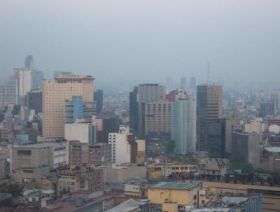
Mexico City once topped lists of places with the worst air pollution in the world. Although efforts to curb emissions have improved the situation, tiny particles called aerosols still clog the air. Now, atmospheric scientists from UC San Diego and six other institutions have sorted through the pall that hangs over the city to precisely identify aerosols that make up the haze and chart daily patterns of changes to the mix.
This forensic work will help to identify the sources of these persistent pollutants, which plague other megacities in places like China and India as well. With this information, leaders will be better able to develop policies that will effectively clear the air.
Using an instrument that can quickly read the size and chemical fingerprint of individual particles one-by-one in real time, the scientists saw a daily rhythm in the chemical makeup of Mexico City's smog. Metal aerosols spiked in the early morning, contributing up to 73 percent of the particles they measured. By afternoon, shifting winds swept these industrial emissions away but blew in smoke particles from fires set to clear agricultural fields or burning in the hills south of the city. Burned bits of biomass accounted for as much as 76 percent of the smallest particles when strong winds flowed directly from the fires, they found.
"Nobody really knew that these kinds of aerosols were so abundant in the center of the city," said Kimberly Prather, professor of chemistry and biochemistry at UC San Diego and senior author on both papers. "Our instrument brings in a new level of precision by allowing us to identify high levels of specific pollutants that occur in transient peaks. A harmful type that is present in high amounts for just a few hours might be overlooked in a sample collected over the course of an entire day and night. But if you live nearby, you still breathe air with concentrated pollutants.
Aerosols with the chemical signature of incinerated waste peaked most weekday mornings during the 20-day study period, the team reports in the early online edition of Environmental Science and Technology. From the top of a building in a mixed industrial and residential area in the northern part of the city, they saw an influx of aerosols that were a combination of lead, zinc and chloride mixed with soot between midnight and 10:00 am.
Although the source of these mixed-metal particles can't be determined with complete certainty from the data collected in this study, the pattern matched that found by a previous study of fly ash from incinerators burning municipal waste. Emissions from smelting, another possible source of metal aerosols, tend not to include chloride or phosphorous, both of which were mixed in with the morning metal aerosols. An absence of metals in the air on weekends and during a holiday, when industrial incinerators were closed, bolsters the case for pinning metals in the air onto burning waste.
"If you were to burn electronic waste, you would get particles very similar to these," said Ryan Moffet, lead author on both papers and a former graduate student at UC San Diego. Moffet now studies atmospheric aerosols at the Lawrence Berkeley National Laboratory.
The source of smoke particles is more clear. Satellite images taken during the experiment show a swath of fires burning in the hills surrounding Mexico City. By matching the types of smog bits they captured to the wind patterns each day, the team was able to attribute the afternoon influx of freshly burned biomass to these distant fires. Winds picked up each morning after 11:00 am, blowing the industrial waste away and bringing smoke from the fires to the south, they report in a forthcoming issue of the journal Atmospheric Chemistry and Physics.
Fuel burned by street vendors also contributes to smoke in the city, the scientists say. "A lot of people use charcoal on the streets to cook their food," Moffet said, "not only in Mexico City but also in cities in China and India that also struggle with air quality."
Source: University of California - San Diego


