CU to show off its 100-mpg car-in-progress at state fair
Aug 19, 2008 By Krishna Ramanujan
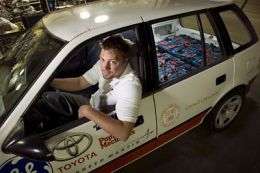
Cornell graduate student Trey Riddle sits in a modified Geo Metro his team is using to test battery packs, generators and braking methods in preparation for competing for the Progressive Automobile X Prize. Jason Koski/University Photography

(PhysOrg.com) -- A car that gets 100 miles a gallon may sound far-fetched, but the biggest challenge in designing a high-mileage hybrid vehicle for the $10 million Progressive Automobile X Prize (AXP) competition in 2010 is not know-how, says Cornell's AXP team. The biggest challenges are space to work in, time and money.

"Our goal is to bring awareness of the technology to the public," said team leader Trey Riddle, a graduate student in Cornell's Department of Mechanical and Aerospace Engineering. "With some creativity and innovation, we have the technology now. This isn't some far-off pie-in-the-sky."

At the 2008 New York State Fair in Syracuse, the Cornell AXP Team will display a pilot car -- a modified 1993 Geo Metro -- though that vehicle's main function is to test drive such technologies as battery packs, electrical generators and regenerative braking schemes. It will look nothing like the sleek final design. The car is part of the Visions New York exhibit at the Americraft Center of Progress Building.

"We should be able to begin building the final car early next year," said Riddle, who leads a team of more than 70 students from various Cornell disciplines, including engineering, ergonomics, and applied economics and management. The biggest design challenges for the team, which is mentored by Al George and John Callister, both Cornell professors of mechanical engineering, are maximizing drive-train efficiency, aerodynamics and keeping the car's weight low while meeting safety standards.

The team's final submission will be a commercially viable plug-in hybrid vehicle that can run on electricity for 40 to 50 miles on a full battery charge. The car's battery will be able to recharge while in motion, using a small diesel-powered onboard generator and regenerative braking. The battery also will charge in six hours when plugged into a standard electrical outlet. The final car must meet tailpipe and wells-to-wheels greenhouse gas emissions standards, seat four people, have 10 cubic feet of cargo space, accelerate to 60 mph in 12 seconds and be able to drive at least 200 miles with an efficiency equivalent to getting 100 miles per gallon. Contest rules also require a business plan that identifies a target market, suggests prices and creates a system for producing, distributing and servicing the vehicle with the goal of bringing to market at least 10,000 vehicles per year.

The AXP's qualifying races will be held in New York City in September 2009 for the 2010 final competition. Races will include urban, highway and racetrack courses.

Cornell and Western Washington University are the only universities in the mainstream auto class of the competition, which has 61 entries. Though a number of smaller automobile makers are competing for the prize, none of the three biggest automakers are involved.

The AXP is offered by the X Prize Foundation, best known for awarding the $10 million Ansari X Prize to Mojave Aerospace Ventures in 2004 for the flight of SpaceShipOne, the first private spacecraft capable of carrying three people to 100 kilometers (62 miles) above the Earth twice within two weeks. The goal of X Prizes is to encourage innovation through competition.

The Cornell team is sponsored by General Electric, Cornell's College of Engineering, National Instruments, Tektronix Inc., Toyota Motor Corp., Autodesk Inc., Cornell Systems Engineering Program, Popular Mechanics, Lockheed Martin, First Manhattan, the Triad Foundation and Exide Technologies.

Provided by Cornell University

Explore further: Radiation leak at Japan lab; small impact expected

add to favorites email to friend print save as pdf

Related Stories

Under the hood of the ribosome

Mar 25, 2013

(Phys.org) —We all know—generally speaking—how a car works: The gas pedal makes it go, the break pedal makes it stop, and the steering wheel determines its course. But pop open the hood and you'll find ...

Cornell team will compete to build 100-mpg car

Jun 09, 2007

Cornell faculty, engineering students and MBA candidates are planning to compete for the Automotive X Prize, which offers a multimillion-dollar award for the team that builds a practical, marketable 100-mpg car.

Study shows promise for East Coast broccoli industry

Jan 09, 2013

Chefs and home cooks in the eastern U.S. could soon have easier access to a local "super food," thanks to a Cornell-led team of researchers working to expand broccoli's availability at farms, farmer's markets ...

The robotic equivalent of a Swiss army knife (w/ video)

Nov 30, 2012

The device doesn't look like much: a caterpillar-sized assembly of metal rings and strips resembling something you might find buried in a home-workshop drawer. But the technology behind it, and the long-range ...

'Ordered' catalyst boosts fuel cell output at lower cost

Nov 01, 2012

(Phys.org)—Fuel cells, which convert fuel directly into electricity without burning it, promise a less polluted future where cars run on pure hydrogen and exhaust nothing but water vapor. But the catalysts ...

Recommended for you

Radiation leak at Japan lab; small impact expected

17 hours ago

An atomic research lab in northern Japan has reported a radiation leak that may have affected about 50 people, though none were hospitalized and no impact was expected outside the facility, the lab's operator ...

The long road to the 2000-watt society

May 24, 2013

The vision of a society in which each inhabitant of the earth manages to consume only 2000 watts (48 kilowatt-hours per day) has already been around for 15 years. During this time, there has been a steady incr ...

Germany must spread cost of energy shift fairly: IEA

May 24, 2013

The International Energy Agency said Friday that Germany must shield its consumers from paying too much of the cost of its ambitious switch from nuclear power and fossil fuels toward renewable energy.

Solar Kettle allows for boiling water off the grid

May 23, 2013

(Phys.org) —A company called Contemporary Energy has unveiled a new device it calls the Solar Kettle. It looks very much like a normal coffee thermos, but has flaps on one side that open to allow for collecting ...

User comments : 2

Adjust slider to filter visible comments by rank

Display comments: newest first

Lord_jag
not rated yet Aug 21, 2008
"Though a number of smaller automobile makers are competing for the prize, none of the three biggest automakers are involved."

10 million is nothing to them. I'm sure when the design is finished they will be sure to buy it up to make their oil fiends good and happy.
lengould100
not rated yet Sep 24, 2008
"none of the three biggest automakers are involved." -- and people wonder why they're going down the drain.

More news stories

Yahoo, pay-TV operators among Hulu bidders

Online video site Hulu is again up for sale, with Yahoo and pay TV operators DirecTV and Time Warner Cable among the seven bidders, according to a person with direct knowledge of the matter.

Radiation leak at Japan lab; small impact expected

An atomic research lab in northern Japan has reported a radiation leak that may have affected about 50 people, though none were hospitalized and no impact was expected outside the facility, the lab's operator ...