Martian soil may contain detrimental substance
Aug 05, 2008
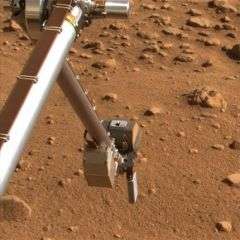
This undated image provided by NASA shows the Phoenix spacecraft's inverted scoop preparing to take soil samples on Mars. NASA's Phoenix spacecraft has detected the presence of a chemically reactive salt in the Martian soil, a finding that if confirmed could make it less friendly to potential life than once believed, according to a report Monday Aug. 4, 2008. (AP Photo/NASA)

Scientists are analyzing results from soil samples delivered several weeks ago to science instruments on NASA's Phoenix Mars Lander to understand the landing site's soil chemistry and mineralogy.

Within the last month, two samples have been analyzed by the Wet Chemistry Lab of the spacecraft's Microscopy, Electrochemistry, and Conductivity Analyzer, or MECA, suggesting one of the soil constituents may be perchlorate, a highly oxidizing substance. The Phoenix team has been waiting for complementary results from the Thermal and Evolved-Gas Analyzer, or TEGA, which also is capable of detecting perchlorate. TEGA is a series of ovens and analyzers that "sniff" vapors released from substances in a sample.

NASA will hold a media teleconference on Tuesday, Aug. 5, to discuss these recent science activities.

Confirmation of the presence of perchlorate and supporting data is important prior to scientific peer review and subsequent public announcements. The results from Sunday's TEGA experiment, which analyzed a sample taken directly above the ice layer, found no evidence of this compound.

"This is surprising since an earlier TEGA measurement of surface materials was consistent with but not conclusive of the presence of perchlorate," said Peter Smith, Phoenix's principal investigator at the University of Arizona, Tucson.

Scientists at the Phoenix Science Operations Center at the University of Arizona are specifically looking at the data from these instruments to provide information on the composition of Martian soil.

"We are committed to following a rigorous scientific process. While we have not completed our process on these soil samples, we have very interesting intermediate results," said Smith, "Initial MECA analyses suggested Earth-like soil. Further analysis has revealed un-Earthlike aspects of the soil chemistry."

The team also is working to totally exonerate any possibility of the perchlorate readings being influenced by terrestrial sources which may have migrated from the spacecraft, either into samples or into the instrumentation.

"When surprising results are found, we want to review and assure our extensive pre-launch contamination control processes covered this potential," said Barry Goldstein, Phoenix project manager at NASA's Jet Propulsion Laboratory in Pasadena, Calif.

Since landing on May 25, Phoenix has been studying Martian soil with MECA's wet chemistry lab, two microscopes and a conductivity probe, TEGA's ovens and two cameras.

MECA's robotic wet chemistry lab studies soluble chemicals in the soil by mixing a soil sample with a water-based solution with several reagents brought from Earth. The inner surface of each cell's beaker has 26 sensors that give information about the acidity or alkalinity and concentrations of elements such as chloride or perchlorate. The beaker also can detect concentrations of magnesium, calcium and potassium, which form salts that are soluble in water.

With continuing results and the spacecraft in good condition, the mission has been extended through Sept. 30. The original prime mission of three months ends in late August. The mission extension adds five weeks to the 90 days of the prime mission.

Provided by NASA

Explore further: Collisions of coronal mass ejections can be super-elastic

add to favorites email to friend print save as pdf

Related Stories

Mars Icebreaker Life mission

May 16, 2013

Missions to Mars have only scratched its surface. To go deeper, scientists are proposing a spacecraft that can drill into the Red Planet to potentially find signs of life.

Searching for organics in a nibble of soil

Feb 20, 2013

You might call it a high-tech panhandler, with its design for sifting through sprinkles of dirt to find tiny specks of organic material. Or you might think of it as a soil-eating-micro-espresso machine that ...

Curiosity rover: No big surprise in first soil test

Dec 03, 2012

(Phys.org)—NASA's Mars Curiosity rover has used its full array of instruments to analyze Martian soil for the first time, and found a complex chemistry within the Martian soil. Water and sulfur and chlorine-containing ...

Curiosity's search for organics

Aug 03, 2012

Soon the rover Curiosity will land on Mars. By design it won't involve life-detection, but it was assembled to look for the carbon-based building blocks of Martian life and to explore the possible habitats ...

Could Curiosity determine if Viking found life on Mars?

Nov 30, 2011

One of the most controversial and long-debated aspects of Mars exploration has been the results of the Viking landers’ life-detection experiments back in the 1970s. While the preliminary findings were ...

Recommended for you

Forecast for Titan: Wild weather could be ahead

16 hours ago

(Phys.org) —Saturn's moon Titan might be in for some wild weather as it heads into its spring and summer, if two new models are correct. Scientists think that as the seasons change in Titan's northern hemisphere, ...

SDO observes mid-level solar flare

16 hours ago

UPDATE 16:30 p.m. EDT: The M7-class flare was also associated with a coronal mass ejection or CME, another solar phenomenon that can send billions of tons of particles into space. While this CME was not Ea ...

NASA's IRIS mission readies for a new challenge

May 22, 2013

(Phys.org) —The time draws near. NASA is getting ready to launch a new mission, a mission to observe a largely unexplored region of the solar atmosphere that powers its dynamic million-degree outer atmosphere and drives ...

User comments : 6

Adjust slider to filter visible comments by rank

Display comments: newest first

DGBEACH
2.3 / 5 (3) Aug 05, 2008

On Earth, perchlorate is a natural and manmade contaminant sometimes found in soil and groundwater. It is the main ingredient in solid rocket fuel and can be found in fireworks, pyrotechnics and other explosives.


But wouldn't this be a GOOD thing, if you needed to get off the planet in a hurry...kabooooooom! :)
ruebi
3 / 5 (3) Aug 05, 2008
mars = middle east of rocket fuel?
when do we send teams of self replicating robots there to start farming is what i wanna know.
Quantum_Conundrum
1.5 / 5 (8) Aug 05, 2008
LOL.

all that garbage about meteors and microbes from mars has been proven wrong...by the very fools who were so caught up in it.

Sterile as a jug of bleach, she is!


Back to the drawing board for evolutionist and abiogenesis brainwashees.
Nederluv
4.2 / 5 (6) Aug 05, 2008
Back to the drawing board for evolutionist and abiogenesis brainwashees.


Life on Mars is/was a possibility.
It doesn't disprove evolution, nothing can. The theory has been proven over and over again by several scientific fields. Speciation and (beneficial) mutations have both been observed. I have 47 chromosomes, so how would you call me: God's freak accident? Denying evolution means you are denying a direct observation. It's like denying stars exist while refusing to look to the sky at night.

Back to school for you!
Modernmystic
1 / 5 (2) Aug 05, 2008
While I'm a whole hearted supporter of evolutionary theory I think that perhaps QC was more reffering to the origins of life, rather than it's unfolding biochemical/evolutionary processes after the fact. However, it's hard to be sure based on reading his...post.
out7x
1 / 5 (2) Aug 07, 2008
I'm still waiting for evidence of water on mars. Please, I took high school chemistry. Perchlorate is ClO4.

More news stories

Century-old science helps confirm global warming

(Phys.org) —Ocean measurements taken more than 135 years ago during the scientific expedition of HMS Challenger have provided further confirmation of human-produced global warming over the past century.

Bacterium from Canadian High Arctic and life on Mars

(Phys.org) —The temperature in the permafrost on Ellesmere Island in the Canadian high Arctic is nearly as cold as that of the surface of Mars. So the recent discovery by a McGill University led team of ...

Chemists find new compounds to curb staph infection

(Phys.org) —In an age when microbial pathogens are growing increasingly resistant to the conventional antibiotics used to tamp down infection, a team of Wisconsin scientists has synthesized a potent new ...

Key find for early bladder cancer treatment

Aggressive forms of bladder cancer involve the protein PODXL – a discovery that could hold the key to improved treatment, according to researchers at Lund University, Uppsala University and KTH in Sweden.