Partial Eclipse, Total Fun
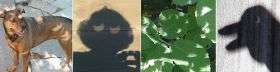
On Friday, August 1st, millions of people in Greenland, Siberia, Mongolia and China—especially China—are going to witness a total eclipse of the sun. The Moon's cool shadow will sweep across the landscape, silencing wildlife with sudden darkness, filling the sky with the sun's ghostly corona, transforming ordinary folks into life-long eclipse chasers. Mainstream media gives this sort of thing saturation coverage.
Totality is a big event, but its not the only event on August 1st. Don't forget the partial eclipse!
While millions of people experience totality, billions will experience a fractional coverage of the sun with many delights of its own. The partial eclipse can be seen from about a quarter of Earth's surface, including all of Asia, most of Europe, the Middle East, India, and the Maine corner of North America. If you live in one of those areas, get ready for fun.
The first thing to remember about a partial eclipse is don't look at it. Even the tiniest sliver of sun left uncovered by the Moon can badly hurt your eyes. They don't call it "blinding sunlight" for nothing.
Instead, look at the ground.
Beneath a leafy tree, you might be surprised to find hundreds of crescent-shaped sunbeams dappling the grass. Overlapping leaves create a myriad of natural little pinhole cameras, each one casting an image of the crescent-sun onto the ground beneath the canopy.
No trees? Try this trick: Criss-cross your fingers waffle-style and let the sun shine through the matrix of holes. You can cast crescent suns on sidewalks, driveways, friends, cats and dogs—you name it. This opens up a seldom-tapped well of possibilities for hand shadows, like the crescent-eyed turkey shown above.
Unlike the total eclipse, which lasts no more than a few minutes while the sun and Moon are perfectly aligned, the partial eclipse goes on for more than an hour--plenty of time for shadow play. The fun begins at sunrise in Quebec, mid-morning in Europe, after lunch in Iraq and late afternoon in India. Graphic artist Larry Koehn has created five animated maps that show when to look: North America, Europe, Middle East, India and Asia.
Of particular interest is a broad line stretching roughly from Nova Scotia, through Quebec and diagonally across the Hudson Bay. There, on Friday morning, August 1st, observers may witness a fiery crescent rising from the waters of the Bay or the Atlantic, dimmed to human visibility by low-hanging clouds and mist. Don't stare. Even "dim suns" are perilous.
At such a time, the temptation to use a telescope or binoculars can be powerful. Again, care is required. Sunlight focused through optics is hot and dangerous to the eyes. Direct viewing should only be attempted with the aid of a safe solar filter. (These are found easily enough by typing "solar filter" or "eclipse glasses" into your favorite search engine.) Or, to be on the safe side, use the 'scope as a projection device, shining a bright crescent on a wall or sidewalk for everyone to see.
When all is said and done, setting all fun aside, it must be admitted that there is no substitute for totality. So NASA, in partnership with UC Berkeley and the Exploratorium, will broadcast the August 1st eclipse from a remote location in China, deep inside the path of totality. Tune into NASA TV this Friday at 6 am EDT for complete coverage.
Source: Science@NASA, by Dr. Tony Phillips


