Uncertain future for elephants of Thailand
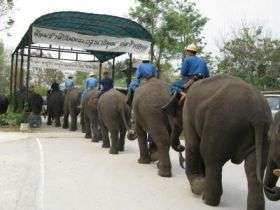
Worries over the future of Thailand' s famous elephants have emerged following an investigation by a University of Manchester team.
Professor Rosaleen Duffy and Dr Lorraine Moore from the University' s School of Social Sciences say many problems have endured since the ending of the logging trade which employed virtually all Thai elephants in 1989.
The ban made 2,000 animals and their Mahouts - or trainers - unemployed overnight, forcing many onto the streets to beg for cash.
Though transferring to the tourism trade has improved working conditions for many elephants, their future remains under a cloud argues Professor Duffy.
"Despite the move into tourism, we have found evidence that street walking persists in some areas and that can be traumatic for the animals and a nuisance for humans," she said.
"And the almost total reliance on the tourist trade makes the Thai elephants especially vulnerable to a downturn in the market.
"If that happens more are forced onto the streets or into inappropriate activities in towns.
"The December 2004 tsunami had - at least to some extent - that effect. The rising oil prises of today are bound to affect air travel and hence tourism as well.
"The elephants are very important in Thai culture, and mahouts generally only beg on the streets with their elephants as an absolute last resort.
"It's a sad outcome for these once proud animals and their trainers."
A powerful symbol of the problem is provided by a video of a baby elephant used to attract people to a Flintstone themed bar in the Phuket resort - taken by Professor Duffy.
The animal is made to stand outside the bar each night to attract customers.
"This a very questionable practice as at night baby elephants will be scared by the lights," she said.
"They shouldn't be forced to stand on concrete for long periods of time as it will damage their feet and be extremely painful according to Dr Moore.
"I also witnessed other poor treatment: for example elephants trained to stand on their heads during a show.
"This is bad practice as the elephant's head is not designed to take its body weight in this posture.
"In addition, a minority of the elephant camps do not provide proper working hours or conditions for their animals."
However, the picture is not all bad: mistreatment of elephants was far more prevalent in the logging industry than in tourism.
According to Professor Duffy and Dr Moore, many of the elephant camps in Thailand treat their animals well.
And the 2000 elephants employed in today' s Thai tourism industry may be used to add the declining elephant gene pool of 1000 wild elephants.
A scheme which trains captive elephants to survive in the wild is undertaken at the Thai Elephant Conservation Centre (TECC).
TECC is also experimenting with alternative schemes to generate income from elephants including elephant dung paper and elephant dung fertiliser.
A TECC project with University of Chiang Mai has found that when autistic children are allowed to interact with the elephants their condition improves.
Mae Sa elephant camp has an elephant nursery which is engaged in artificial insemination.
The Manchester team hope to repeat their research in Botswana later in the year and aim to publish advice for tourist companies and guide books working in both countries. Some southern African countries are starting to train African elephants for elephant back safaris.
Professor Duffy added: " We hope this project will provide the impetus for travel companies and travel guide authors to provide information to their clients and readers on how and where to report cruelty to elephants."
Source: University of Manchester


