New finding in rare eye disease
July 14, 2008

New finding in rare eye disease

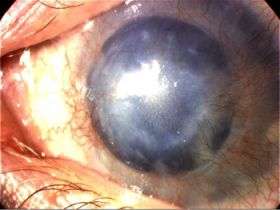
(PhysOrg.com) -- Researchers have made a finding which could pave the way for new treatments for sufferers of a rare eye disease which can lead to blindness.

In a paper published in the Journal of Pathology, scientists reveal they have discovered why mutations in a key gene can cause the cornea to go opaque and lead to sight loss.

Pax6 is the gene responsible for the development of the eye and mutations of it can cause the cornea to go cloudy.

Corneas - our windows on the world – are delicate, transparent tissues which are constantly exposed to potentially damaging environmental factors such as daylight, ultraviolet light and high levels of oxygen.

Normal corneas contain proteins that protect against the day to day stress of coping with these environmental stresses.

But around one in 40,000 people have Pax6 mutations which lead to them developing a condition called Aniridia, where the iris of the eye is missing.

As well as having no iris, most sufferers will develop some degree of corneal cloudyness which is called Aniridia-Related Keratopathy or ARK.

Now researchers have found that people with ARK have tiny holes in their corneas, which open up the corneas to extra levels of stress. They also discovered that they have less of the protective proteins, which results in their eyes being unable to cope with everyday conditions. Over time, this leads to the corneas going cloudy.

Dr Martin Collinson, a Senior Lecturer in Biomedical Sciences at the University of Aberdeen, led the research team. He said: "In the worst cases Aniridia-Related Keratopathy can be chronically painful and sight threatening. Current therapy is surgery, anti-inflammatory drugs, or nothing at all."

The researchers found that if they applied chemicals to diseased corneas, they were able to reduce the stress caused by oxygen. This in turn gave cells on the eye's surface more of a fighting chance of protecting the eye.

Dr Collinson added: "Our findings provide answers to a disease that has been very poorly understood and is rather difficult to treat.

"We hope that our studies could potentially lead to new treatments for people with ARK that could involve eye drops as opposed to surgery."

Source: University of Aberdeen

4.4 /5 (5 votes)  

Rank 4.4 /5 (5 votes)
Tags

Relevant PhysicsForums posts

More news stories

T cells 'hunt' parasites like animal predators seek prey, study shows

By pairing an intimate knowledge of immune-system function with a deep understanding of statistical physics, a cross-disciplinary team at the University of Pennsylvania has arrived at a surprising finding: T cells use a movement ...

Medicine & Health / Medical research

created 11 hours ago | popularity 5 / 5 (4) | comments 0 | with audio podcast

Same gene that stunts infants' growth also makes them grow too big: research

UCLA geneticists have identified the mutation responsible for IMAGe* syndrome, a rare disorder that stunts infants' growth. The twist? The mutation occurs on the same gene that causes Beckwith-Wiedemann syndrome, which makes ...

Medicine & Health / Genetics

created 11 hours ago | popularity not rated yet | comments 0 | with audio podcast

Almost half of new vets seek disability

(AP) -- America's newest veterans are filing for disability benefits at a historic rate, claiming to be the most medically and mentally troubled generation of former troops the nation has ever seen.

Medicine & Health / Health

created 9 hours ago | popularity not rated yet | comments 0

Color-changing contact lenses to help diabetics (w/ Video)

For the millions of Americans with diabetes, the inconvenient and often painful method of testing blood sugar levels is a way of life. But research and innovative product design by scientists at The University of Akron may ...

Medicine & Health / Diabetes

created May 23, 2012 | popularity 4.4 / 5 (7) | comments 5 | with audio podcast

Missouri opts for untested drug for executions

(AP) -- The same anesthetic that caused the overdose death of pop star Michael Jackson is now the drug of choice for executions in Missouri, causing a stir among critics who question how the state can guarantee ...

Medicine & Health / Medications

created May 24, 2012 | popularity not rated yet | comments 5


'Unzipped' carbon nanotubes could help energize fuel cells, batteries

Multi-walled carbon nanotubes riddled with defects and impurities on the outside could replace some of the expensive platinum catalysts used in fuel cells and metal-air batteries, according to scientists at ...

Change in developmental timing was crucial in the evolutionary shift from dinosaurs to birds: study

At first glance, it's hard to see how a common house sparrow and a Tyrannosaurus Rex might have anything in common. After all, one is a bird that weighs less than an ounce, and the other is a dinosaur that ...

Computer model used to pinpoint prime materials for efficient carbon capture

When power plants begin capturing their carbon emissions to reduce greenhouse gases – and to most in the electric power industry, it's a question of when, not if – it will be an expensive undertaking.

Yale study concludes public apathy over climate change unrelated to science literacy

Are members of the public divided about climate change because they don't understand the science behind it? If Americans knew more basic science and were more proficient in technical reasoning, would public consensus match ...

Land and sea species differ in climate change response: study

(Phys.org) -- Marine and terrestrial species will likely differ in their responses to climate warming, new research by Simon Fraser University and Australia’s University of Tasmania has found.

Stunning image of smallest possible five-ringed structure

Scientists have created and imaged the smallest possible five-ringed structure – about 100,000 times thinner than a human hair – and you'll probably recognise its shape.