Forest birds evolved early, DNA shows
Jul 10, 2008
Forest birds evolved early, DNA shows
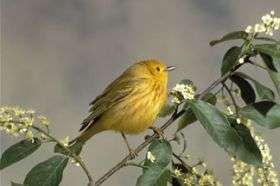
A yellow warbler. Courtesy Mike Hopiak

(PhysOrg.com) -- Evolution seems to have happened in fits and starts -- at least that's what the fossil record shows. From trilobites to pterodactyls, ammonites to Archaeopteryx, scientists find the same pattern: brief bursts of innovation in which a single species or branch on the tree of life turns into a cluster of new twigs, then lapses into long stretches ruled by the status quo.

The question is why. Is the fossil record incomplete -- are fossil beds just snapshots of a process that occurs at a steady pace throughout time? Or might changing environmental or geologic conditions alter the rate at which species arise?

"It's arguably one of the most fundamental questions in all of evolutionary biology," said Dan Rabosky, a graduate student at the Cornell Laboratory of Ornithology and lead author of a new analysis of the problem, published online July 9 in the journal Proceedings of the Royal Society B. "How do species arise? Where does all this biodiversity that we see on Earth come from?"

Rabosky and co-author Irby Lovette, director of the Fuller Evolutionary Biology Program at the Lab of Ornithology, used DNA analyses to look at 5 million years of evolution in 25 species of colorful North American songbirds known as wood warblers. They discovered that a flurry of species divergence occurred early on, with many species appearing in just the first million years.

Rabosky and Lovette developed a new mathematical model that attributed the pattern to the way closely related species divide up their environment. At first, with few relatives around to compete with, species can differentiate rapidly. But as the species list grows, competition becomes fiercer and leads to fewer opportunities for additions.

"Right after the dinosaurs went extinct, most people are aware that there was a huge explosion of mammal diversity," Rabosky said. "That extinction created lots of ecological 'space' -- opportunities for new species of mammals to take advantage of resources. On a much smaller scale of both space and time, this little group of warblers from North America might be playing out the same story."

The pattern of rapid diversification is well known to biologists -- they've even coined a name for the process: "adaptive radiation." But the best-known examples tend to involve geographic isolation: Darwin's finches of the Galapagos, anole lizards of the Caribbean and the marvelously colorful cichlid fishes of Africa's inland lakes.

"What's interesting is that this happened on a continent where it's ecologically much more complex than an island," Rabosky said. "You've got lots of competitors. Clearly, lots of other birds were already here, eating insects and probably doing what warblers do now."

Rabosky and Lovette chose to study the warbler genus Dendroica and to use DNA analyses because they needed a detailed picture of the genetic relationships among the 25 species -- a level of information that fossils simply can't provide. Those details let them reconstruct, species by species, the chronological order in which new species appeared.

And besides, 4-inch-long, half-ounce forest birds don't leave much of a fossil record.

"In fact," Rabosky said, "the vast majority of biodiversity on this planet that we need to explain doesn't have a fossil record. But just by using species that are alive today and looking at their DNA, we can see the signal of an early explosion of species millions of years ago."

Hugh Powell is a staff writer at Cornell's Lab of Ornithology.

Source: Cornell University

Explore further: Front-row seats to climate change

add to favorites email to friend print save as pdf

Related Stories

Naming evolution's winners and losers

Jul 29, 2009

(PhysOrg.com) -- Mammals and many species of birds and fish are among evolution's "winners," while crocodiles, alligators and a reptile cousin of snakes known as the tuatara are among the losers, according ...

Recommended for you

Front-row seats to climate change

20 hours ago

By day, insects provide the white noise of the South, but the night belongs to the amphibians. In a typical year, the Southern air hangs heavy from the humidity and the sounds of wildlife.

Climate change may have little impact on tropical lizards

May 17, 2013

A new Dartmouth College study finds human-caused climate change may have little impact on many species of tropical lizards, contradicting a host of recent studies that predict their widespread extinction in a rapidly warming ...

Wetlands: value to locals matters most

May 17, 2013

A new way of valuing ecosystem services, incorporating the local perspective, is the driving force behind a project assessing aquatic ecosystems in highland areas of Asia

User comments : 3

Adjust slider to filter visible comments by rank

Display comments: newest first

bobwinners
not rated yet Jul 11, 2008
Anyone care to speculate on the reason behind the
"brief bursts of innovation"?
mabarker
1 / 5 (2) Jul 11, 2008
Yes, Bob. It sounds very much like abrupt appearance followed by minor variation - which is what The Alternative to Darwinism states.
"Brief bursts of innovation" is a vague & imprecise statement - esp. in light of what 4 Darwinists said in '89: "Natural selection can act only on those biological properties that already exist; it cannot create properties in order to meet adaptational needs" Noble, et al.
Life appears abruptly in the f.r. in a very undarwinian manner. See Figures 5-6 & 19-10 of Colbert's 5th edition.
jeffsaunders
5 / 5 (1) Sep 30, 2008
Yes Bob,

Evolution occurs constantly but has little effect without availability. Diversification requires vacancies of competition.

In cases of invasion of one species into new territory - if that species survives more easily in that territory it is basically the same as that species entering virgin territory.

Evolution therefore shows the illusion of dramatic change over short period of time while opportunity exists - once opportunity no longer exists then all those variations that are continually occurring fail to find fertile footholds.

Darwin triumphs as usual. A great many scientists get bogged down in inconsequential details that are off-the-track but hey they are only human.

Whenever life becomes too easy we will find species will diversify. True many people consider it the challenge of overcoming a new environment but that is not the case. Diversification occurs when there is more than one way of successful resolution to a problem.

That is the driving force of evolution and it is the engine behind the entire animal kingdom. So you put one species into a location where life is easy and it will gradually develop variations on a theme which will continue until you end up with extremely diverse range of creatures.

More news stories

Front-row seats to climate change

By day, insects provide the white noise of the South, but the night belongs to the amphibians. In a typical year, the Southern air hangs heavy from the humidity and the sounds of wildlife.

Morocco to harness the wind in energy hunt

Morocco is ploughing ahead with a programme to boost wind energy production, particularly in the southern Tarfaya region, where Africa's largest wind farm is set to open in 2014.

Bernanke forecasts gains from computer technology

(AP)—Federal Reserve Chairman Ben Bernanke says pessimists who are forecasting that the economy will not reap sizable benefits from the computer revolution are likely to be proven wrong.

US psychiatry gets makeover in new manual

The latest makeover to a massive psychiatric tome honored by some, reviled by others and even called the "Bible" of mental disorders is being released Saturday with a host of new changes.

New case of SARS-like virus in Saudi: ministry

A new case of the deadly coronavirus has been detected in Saudi Arabia where 15 people have already died after contracting it, the health ministry announced on Saturday on its Internet website.