Software Helps Developers Get Started with PIV Cards
Jul 10, 2008
Software Helps Developers Get Started with PIV Cards
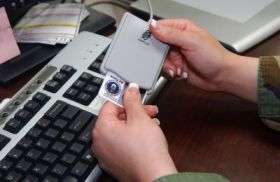
The NIST demonstration software provides examples of incorporating Personal Identity Verification cards to control access to government computers. As shown, an employee will have to swipe her PIV card that holds her unique identifying information before she can access her computer. Credit: Department of Defense

The National Institute of Standards and Technology has developed two demonstration software packages that show how Personal Identity Verification (PIV) cards can be used with Windows and Linux systems to perform logon, digital signing and verification, and other services. The demonstration software, written in C++, will assist software developers, system integrators and computer security professionals as they develop products and solutions in response to Homeland Security Presidential Directive 12 and the FIPS 201-1 standard.

"We wanted to provide IT professionals with a model of one way that PIV cards can be used to support authentication to federal information systems," explains Donna Dodson, deputy director of the NIST Computer Security Division. "Our objective was not to say 'do the steps this way,' but to show an example of how you might proceed."

Homeland Security Presidential Directive 12 calls for government employees and contractors to use secure identity credentials to access federal facilities and computers. NIST worked with industry to develop the standards for the PIV cards that will be used for those purposes. Each card contains a unique number, two of the employee's biometric fingerprint templates, and cryptographic keys stored on an electronic chip embedded in the card's plastic body.

While each federal agency will implement the use of PIV cards on its own schedule, NIST computer scientists developed the software to demonstrate that PIV cards can work with common computer activities such as system logon. The typical process of keying in user name and password will be replaced with the user inserting his/her PIV card in a reader and entering a personal identification number (PIN). This secure logon could eliminate the need for passwords for other applications and could provide access to secure databases to which the user is authorized.

The PIV Crypto Service Provider (CSP) demonstrates Windows XP Logon with PIV cards. The Public Key Cryptography Standard #11 module was developed to operate in the Fedora Core 5 environment and to implement Linux Logon, signing and encrypting email (following the S/MIME standard) and Web site authentication (following the SSL/TLS standard), configured in Linux OS, Thunderbird and Firefox applications.

The software is available at csrc.nist.gov/groups/SNS/piv/download.html

Source: National Institute of Standards and Technology

Explore further: Ecologists warn of overreliance on unvetted computer source code by researchers

add to favorites email to friend print save as pdf

Related Stories

Android, Samsung extend smartphone lead

37 minutes ago

Google's Android mobile operating system grabbed three out of four smartphones sold in the world in the first quarter of 2013, extending its gains over Apple and its iPhone, a survey showed Tuesday.

Advertising product results? Put images closer together

46 minutes ago

Consumers believe a product is more effective when images of the product and its desired outcome are placed closer together in advertisements, according to a new study in the Journal of Consumer Research.

Dell raises intrigue by rescheduling 1Q report

56 minutes ago

Struggling personal computer maker Dell is going to report its latest quarterly earnings ahead of schedule in a move likely to spur speculation that the results will be dismal.

Recommended for you

Research finds new channels to trigger mobile malware

May 16, 2013

(Phys.org) —Researchers at the University of Alabama at Birmingham (UAB) have uncovered new hard-to-detect methods that criminals may use to trigger mobile device malware that could eventually lead to targeted ...

Fewer Facebook users take a liking to its new Home software

May 16, 2013

It may be too soon to call Facebook Home a flop. But it's clearly not the breakout hit that some expected. One month after its splashy debut, fewer and fewer people are downloading Facebook's new mobile software. It took ...

Google adds player matching to Android

May 15, 2013

Google is adding leaderboards and the ability to match players in online games to its Android operating system for smartphones and tablet computers.

User comments : 0

More news stories

Philippines approves three new wind farms

The Philippines has approved three wind farm projects that will generate 208 megawatts, enough to power more than 40,000 middle-class homes, an energy official said on Monday.

Tiny, implantable coil promises hope for emphysema patients

A small, easily implantable device called the Lung Volume Reduction Coil (LVRC) may play a key role in the treatment of two types of emphysema, according to a study conducted in Europe. Results of the study indicate the beneficial ...