Coal-generated CO2 captured in Australia -- a first
Jul 09, 2008
Coal-generated CO2 captured in Australia -- a first
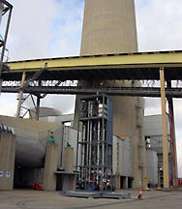
The PCC pilot rig at Loy Yang Power Station has captured carbon dioxide for the first time.

In a first for Australia, carbon dioxide (CO2) has been captured from power station flue gases in a post-combustion-capture (PCC) pilot plant at Loy Yang Power Station in Victoria’s Latrobe Valley.

CSIRO Energy Technology Chief, Dr David Brockway, said the milestone followed the Garnaut Report’s recognition that Australia has an important role to play in developing low emission coal technologies such as PCC.

“PCC uses a liquid to capture CO2 from power station flue gases and can potentially reduce CO2 emissions from existing and future coal-fired power stations by more than 85 per cent,” he said.

“Coal is the primary fuel for over 80 percent of Australia’s current power supply – it’s what turns the lights on in most homes – so we need to find ways to make it a cleaner energy source. This is the first time anyone in the Southern Hemisphere has captured CO2 using the PCC process at a power station and we are thrilled we’ve been able to prove this technology,” Dr Brockway said.

The 10.5 metre-high pilot plant is designed to capture up to 1000 tonnes of CO2 per annum from the power station’s exhaust-gas flues. Future trials will involve the use of a range of different CO2-capture liquids.

CSIRO is undertaking similar PCC research at Munmorah near NSW and Beijing, China, and is negotiating the installation of another pilot plant at a Queensland site.

“Climate change is a key issue for Australia and we’re delighted to be part of finding a solution to this global challenge,” Loy Yang Power Chief Executive Ian Nethercote said.

“We’re pleased to be working with CSIRO to identify ways to significantly reduce greenhouse gas emissions from the energy sector,” Mr Nethercote said.

The project is part of the Latrobe Valley Post Combustion Capture Project – a joint collaboration between Loy Yang Power, International Power Hazelwood, government and researchers from CSIRO’s Energy Transformed Flagship and the CO2CRC (including Monash and Melbourne Universities). The Loy Yang component of the project is supported by the Victorian Government for A$2.5million through the Energy Technology Innovation Strategy.

Source: CSIRO

Explore further: Mathematical algorithms cut train delays

add to favorites email to friend print save as pdf

Related Stories

A robot that runs like a cat (w/ Video)

12 hours ago

Thanks to its legs, whose design faithfully reproduces feline morphology, EPFL's 4-legged 'cheetah-cub robot' has the same advantages as its model: It is small, light and fast.

Beyond NYC: Other places adapting to climate, too

20 hours ago

From Bangkok to Miami, cities and coastal areas across the globe are already building or planning defenses to protect millions of people and key infrastructure from more powerful storm surges and other effects ...

China paper hits out at US surveillance programme

20 hours ago

China's official army newspaper on Sunday branded the United States Internet surveillance programme exposed by former spy Edward Snowden as "frightening", and accused the US of being a "habitual offender" ...

German spy service plans 'more online surveillance'

20 hours ago

Germany's foreign intelligence service plans a major expansion of Internet surveillance despite deep unease over revelations of US online spying, Der Spiegel news weekly reported on Sunday.

Recommended for you

Mathematical algorithms cut train delays

10 hours ago

Commuters are already seeing a reduction in delays and waiting times thanks to new software able to adapt railway schedules in real time following unforeseen disruptions.

Faster, more precise airstrikes within reach

Jun 17, 2013

Air-ground fire coordination—also known as Close Air Support or CAS—is a dangerous and difficult business. Pilots and dismounted ground agents must ensure they hit only the intended target using just ...

How smart technology could change public transit

Jun 17, 2013

Joseph Chow has an ambitious goal: to transform how urban transportation systems are managed and designed, using mobile computing, information technology and the analysis of massive data sets.

User comments : 1

Adjust slider to filter visible comments by rank

Display comments: newest first

lengould100
not rated yet Oct 01, 2008
Give us a break!

"This is the first time anyone in the Southern Hemisphere has captured CO2 using the PCC process at a power station"

Could the specifics of this "FIRST" get any more detailed?

More news stories

Origins of 'The Hoff' crab revealed (w/ Video)

The history of a new type of crab, nicknamed 'The Hoff' because of its hairy chest, which lives around hydrothermal vents deep beneath the Southern Ocean and Indian Ocean, has been revealed for the first ...