FSU researcher using computers to hone cancer-fighting strategies
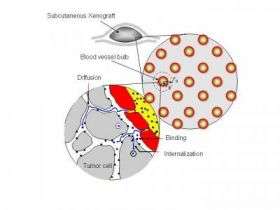
A graphic representation of a vascular tumor model viewed in different scales is shown. Credit: Florida State University
A Florida State University faculty member who uses computational techniques to evaluate a new class of cancer-killing drugs is attracting worldwide attention from other researchers.
Kevin C. Chen, an assistant professor of chemical and biomedical engineering at the Florida A&M University-Florida State University College of Engineering, is using high-powered computers to determine how substances known as recombinant immunotoxins can best be modified in order to attack and kill malignant tumors while doing minimal harm to a patient's healthy cells.
"Cancer is a disease of tremendous complexity, so the analysis and interpretation of data demands sophisticated, specialized computational methods," Chen said of his research.
Recombinant immunotoxins, Chen explained, are new drugs that are being tested in clinical trials for certain types of cancer therapy. They consist of tiny fragments of antibody proteins that are fused at the genetic level to toxins produced by certain types of bacteria, fungi or plants.
"Once injected into the body, the antibody portion of the immunotoxin targets specific proteins, called antigens, that are massively expressed on the surface of cancer cells," Chen said. "These cells are subsequently killed by the accompanying toxins. Normal, healthy cells, meanwhile, are not recognized and thus are spared."
That is the theory, at least. In practice, Chen acknowledges that numerous factors can decrease the immunotoxins' effectiveness. Among them:
*The large size of some immunotoxin molecules can hinder their ability to move to the targeted location to bind readily with cancer cell proteins, leading to efforts to reduce their size.
*The immunotoxin molecules' stability in the bloodstream and in the extracellular matrix can affect their length of time in circulation and in tumor tissues, respectively, thereby determining their effectiveness at killing the optimal number of cancer cells.
*The rate at which immunotoxins bind with malignant cells and the relative amount of antigens expressed on the cell surface are especially critical factors, because an imbalance in those two factors may result in over-bombardment of a single cancer cell with excessive numbers of immunotoxins, leaving many other cancer cells unharmed. The opposite scenario also is possible: If not enough immunotoxins bind with malignant cells, too few cells will be killed with each dose.
"Because the level of anticancer drug doses that can be given to any patient is limited by immunogenicity -- the immune response that results -- it is essential to explore how the efficacy of recombinant immunotoxins can be enhanced without resorting to escalating doses," Chen said. "Our computational research has enabled us to quantify and develop models describing many of the factors that influence immunotoxins' behavior in the body. This is essential knowledge that cancer researchers and doctors must have in order to take the next steps forward in developing immunotoxin drugs that might one day be approved as a standard treatment for cancer patients."
Source: Florida State University
-
From lemons to lemonade: Reaction uses carbon dioxide to make carbon-based semiconductor,
33 comments
-
Thioridazine kills cancer stem cells in human while avoiding toxic side-effects of conventional cancer treatments,
3 comments
-
SpaceX private rocket blasts off for space station (Update),
42 comments
-
Landmark calculation clears the way to answering how matter is formed,
55 comments
-
Research team claims to have found evidence Lake Cheko is impact crater for Tunguska Event,
18 comments
-
Potential Breakthrough in Seizure Control
May 26, 2012
-
Popping/Cracked sternum.
May 25, 2012
-
Which Mental Illness Encompasses This Problem?
May 25, 2012
-
A question about drug tolerance
May 23, 2012
-
Poor nutrition leading to overeating?
May 23, 2012
-
Math and dyslexia?
May 21, 2012
- More from Physics Forums - Medical Sciences
More news stories
T cells 'hunt' parasites like animal predators seek prey, study shows
By pairing an intimate knowledge of immune-system function with a deep understanding of statistical physics, a cross-disciplinary team at the University of Pennsylvania has arrived at a surprising finding: T cells use a movement ...
Medicine & Health / Medical research
11 hours ago |
5 / 5 (4) |
0
|
Same gene that stunts infants' growth also makes them grow too big: research
UCLA geneticists have identified the mutation responsible for IMAGe* syndrome, a rare disorder that stunts infants' growth. The twist? The mutation occurs on the same gene that causes Beckwith-Wiedemann syndrome, which makes ...
11 hours ago |
not rated yet |
0
|
Almost half of new vets seek disability
(AP) -- America's newest veterans are filing for disability benefits at a historic rate, claiming to be the most medically and mentally troubled generation of former troops the nation has ever seen.
9 hours ago |
not rated yet |
0
Color-changing contact lenses to help diabetics (w/ Video)
For the millions of Americans with diabetes, the inconvenient and often painful method of testing blood sugar levels is a way of life. But research and innovative product design by scientists at The University of Akron may ...
May 23, 2012 |
4.4 / 5 (7) |
5
|
Missouri opts for untested drug for executions
(AP) -- The same anesthetic that caused the overdose death of pop star Michael Jackson is now the drug of choice for executions in Missouri, causing a stir among critics who question how the state can guarantee ...
Medicine & Health / Medications
May 24, 2012 |
not rated yet |
5
'Unzipped' carbon nanotubes could help energize fuel cells, batteries
Multi-walled carbon nanotubes riddled with defects and impurities on the outside could replace some of the expensive platinum catalysts used in fuel cells and metal-air batteries, according to scientists at ...
Change in developmental timing was crucial in the evolutionary shift from dinosaurs to birds: study
At first glance, it's hard to see how a common house sparrow and a Tyrannosaurus Rex might have anything in common. After all, one is a bird that weighs less than an ounce, and the other is a dinosaur that ...
Computer model used to pinpoint prime materials for efficient carbon capture
When power plants begin capturing their carbon emissions to reduce greenhouse gases and to most in the electric power industry, it's a question of when, not if it will be an expensive undertaking.
Yale study concludes public apathy over climate change unrelated to science literacy
Are members of the public divided about climate change because they don't understand the science behind it? If Americans knew more basic science and were more proficient in technical reasoning, would public consensus match ...
Land and sea species differ in climate change response: study
(Phys.org) -- Marine and terrestrial species will likely differ in their responses to climate warming, new research by Simon Fraser University and Australia’s University of Tasmania has found.
Stunning image of smallest possible five-ringed structure
Scientists have created and imaged the smallest possible five-ringed structure about 100,000 times thinner than a human hair and you'll probably recognise its shape.