NASA Goddard mission approved to probe matter in extreme environments
Jun 28, 2008
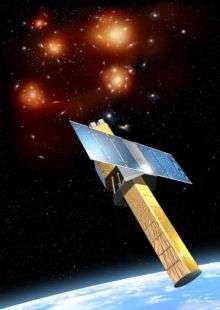
NeXT Satellite with SXS Instrument
Artist's rendition of of NeXT with galaxies in the background -- one of the things it will study. Credit: NASA

An instrument to study the extreme environments of the universe has been given the "green light" from NASA Headquarters. The High-Resolution Soft X-Ray Spectrometer (SXS) was one of the two science proposals recently selected by NASA for the Explorer Program Mission of Opportunity investigations, and is managed at NASA's Goddard Space Flight Center in Greenbelt, Md.

The SXS, to be developed at Goddard, will be installed on the Japan Aerospace Exploration Agency's New exploration X-Ray Telescope, or NeXT. The observatory, currently planned for launch in 2013, will open a new observing window on X-rays and the study of astrophysical phenomena. NASA's proposed funding for the instrument and operations is $44 million.

"We are thrilled to have the opportunity to create a powerful new x-ray spectrometer that will open up a whole new realm in high energy astrophysics in collaboration with our partners in Japan," said Richard L. Kelley, the Principal Investigator for the SXS mission at Goddard. We have a great team in place that is anxiously waiting to start work."

The SXS will probe matter in extreme environments; investigate the nature of dark matter on large scales in the universe; and explore how galaxies and clusters of galaxies form and evolve.

Charles Gay, deputy associate administrator for NASA's Science Mission Directorate in Washington said missions like SXS "expand NASA's science through partnerships with international and commercial organizations."

The SXS was one of two investigations selected from among 17 proposals received by NASA earlier this year. They were evaluated by peer reviewers.

Source: NASA/Goddard Space Flight Center

Explore further: Plan for modified European rocket gets backing

add to favorites email to friend print save as pdf

Related Stories

Recommended for you

Earth-passing asteroid is 'an entirely new beast'

18 hours ago

On the last day of May 2013 asteroid 1998 QE2 passed relatively closely by our planet, coming within 6 million kilometers… about 15 times the distance to the Moon. While there was never any chance of an ...

Details of Yuri Gagarin's tragic death revealed

18 hours ago

On the morning of April 12, 1961, Soviet cosmonaut Yuri Gagarin lifted off aboard Vostok 1 to become the first human in space, spending 108 minutes in orbit before landing via parachute in the Saratov region ...

Russia fetes 50th anniversary of first woman in space

Jun 16, 2013

Russia celebrated Sunday the 50th anniversary of the maiden flight of the first woman in space—a Soviet national hero who went by the call name "Seagull" and captured the imaginations of girls around the ...

Europe's space truck docks with ISS

Jun 15, 2013

A robot freighter bearing 6.6 tonnes of cargo docked with the International Space Station (ISS) on Saturday, the European Space Agency (ESA) said.

User comments : 0

More news stories

Predators affect the carbon cycle, researchers show

A new study shows that the predator-prey relationship can affect the flow of carbon through an ecosystem. This previously unmeasured influence on the environment may offer a new way of looking at biodiversity management and ...

Final curtain for Europe's deep-space telescope

The deep-space telescope Herschel took its final bow on Monday, climaxing a successful four-year mission to observe the birth of stars and galaxies, the European Space Agency (ESA) said.

New language discovery reveals linguistic insights

A new language has been discovered in a remote Indigenous community in northern Australia that is generated from a unique combination of elements from other languages. Light Warlpiri has been documented by University of Michigan ...