Nanotubes could aid understanding of retrovirus transmission between human cells
Recent findings by medical researchers indicate that naturally occurring nanotubes may serve as tunnels that protect retroviruses and bacteria in transit from diseased to healthy cells — a fact that may explain why vaccines fare poorly against some invaders.
To better study the missions of these intercellular nanotubes, scientists have sought the means to form them quickly and easily in test tubes.
Sandia National Laboratories researchers have now learned serendipitously to form nanotubes with surprising ease.
“Our work is the first to show that the formation of nanotubes is not complicated, but can be a general effect of protein-membrane interactions alone,” says Darryl Sasaki of Sandia’s Bioscience and Energy Center.
Sandia is a National Nuclear Security Administration laboratory.
The tunnel-like structures have been recognized only recently as tiny but important bodily channels for the good, the bad, and the informational.
In addition to providing protected transport to certain diseases, the nanotubes also seem to help trundle bacteria to their doom in the tentacles of microphages. Lastly, the nanotubes may provide avenues to send and receive information (in the form of chemical molecules) from cell to cell far faster than their random dispersal into the bloodstream would permit.
Given the discovery of this radically different transportation system operating within human tissues, it was natural for researchers to attempt to duplicate the formation of the nanotubes. In their labs, they experimented with giant lipid vesicles that appeared to mimic key aspects of the cellular membrane.
Giant lipid vesicles resemble micron-sized spherical soap bubbles that exist in water. They are composed of a lipid bilayer membrane only five nanometers thick.
The object for experimenters was to create conditions in which the spheres would morph into cylinders of nanometer radii.
But researchers had difficulties, says Sasaki, perhaps because they used a composite lipid called egg PC that requires unnecessarily high energies to bend into a tubular shape.
Egg PC is inexpensive, readily available, and offers good, stable membrane properties. It is the usual lipid of choice in forming nanocylinders via mechanical stretching techniques.
But Sandia postdoctoral researcher Haiqing Lui instead used POPC — a single pure lipid requiring half the bending energy of egg PC.
She was trying to generate nanotubes by a completely different approach that involved the use of motor proteins to stretch naturally occurring membranes into tubes.
Working with Sandia researcher George Bachand, she serendipitously found that interaction of the POPC membrane with a high affinity protein called streptavidin alone was enough to form the nanotubes.
“Perhaps this information — linking membrane bending energy with nanotube formation — may provide some clue about the membrane structure and the cell’s ability to form such intercellular connections,” Sasaki says.
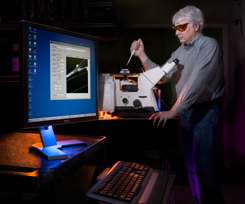
The formation was confirmed by Sandia researcher Carl Hayden, who characterized the nanotube formation through a confocal imaging microscope. The custom instrument allows pixel-by-pixel examination of the protein interaction with the membranes comprising the nanotubes by detecting the spectrum and lifetimes of fluorescent labels on the proteins.
Nanotube formation had been noticed previously by cell biologists, but they had dismissed the tiny outgrowths as “junk — an aberration of cells growing in culture,” says Sasaki. “The reason they were only noticed recently as trafficking routes is because of labeling studies that marked organelles and proteins. This allowed a focused look at what these nanostructures might be used for.”
It became clear, says Sasaki, that the organelles were being transported with “specific directionality” on the backs of motor proteins within the tubes, rather than randomly.
Three-dimensional networks of nanotubes also are found to be created by macrophages — part of the police force of the body — grown in culture, says George. The tubes in appearance and function resemble a kind of spider web, capturing bacterium and transporting them to the macrophages, which eat them.
Other paper authors include postdoc Hahkjoon Kim and summer intern Elsa Abate.
Source: Sandia Corporation


