Water inside single-walled carbon nanotubes
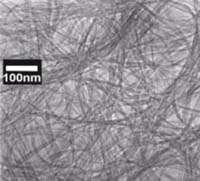
Researchers have identified a signature for water inside single-walled carbon nanotubes, helping them understand how water is structured and how it moves within these tiny channels.
This is the first time researchers were able to get a snapshot of the water inside the carbon nanotubes.
Single-walled carbon nanotubes (SWCNTs) offer the potential to act as a unique nanofiltration system. While experiments have demonstrated extremely fast flow in these channels, it is still unclear why, and few studies have experimentally probed the detailed structure and movement of the water within nanotubes.
That's where Lawrence Livermore scientists Jason Holt, Julie Herberg, and University of North Carolina's, Yue Wu and colleagues come in.
As described in an article appearing in the July edition of Nanoletters, they used a technique called Nuclear Magnetic Resonance (NMR) to get a glimpse of the water confined inside one-nanometer diameter SWCNTs.
The nanotubes, special molecules made of carbon atoms in a unique arrangement, are hollow and more than 50,000 times thinner than a human hair. The confined water exhibited very different properties from that of bulk water, and this allowed it to be distinguished in the NMR spectrum.
Carbon nanotubes have long been touted for their superior thermal, mechanical and electrical properties, but recent work suggests they can be used as nanoscale filters.
Earlier Livermore studies have suggested that carbon nanotubes may be used for desalination and demineralization because of their small pore size and enhanced flow properties. Conventional desalination membranes are typically much less permeable and require large pressures, entailing high energy costs. However, these more permeable nanotube membranes could reduce the energy costs of desalination significantly.
While the technology offers great promise, there still are important unanswered scientific questions.
"There have been many predictions about how water behaves within carbon nanotubes," said Holt, the principal investigator of the project, which is funded through LLNL's Laboratory Directed Research and Development (LDRD). "With experiments like these, we can directly probe that water and determine how close those predictions were."
Source: DOE/Lawrence Livermore National Laboratory


