Scientists fix bugs in our understanding of evolution
Jun 19, 2008
Sequence Alignment
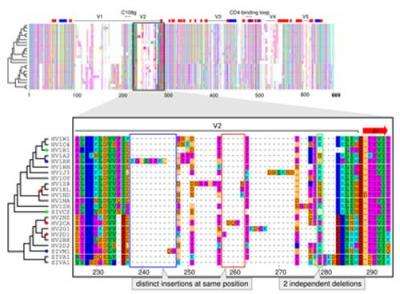
Caption: Sequence alignment according to the new, phylogeny-aware method. Credit: Nick Goldman, EMBL-EBI

[B]A new computational tool allows the most accurate insights into evolution ever[/B]
What makes a human different from a chimp? Researchers from the European Molecular Biology Laboratory's European Bioinformatics Institute [EMBL-EBI] have come one important step closer to answering such evolutionary questions correctly. In the current issue of Science they uncover systematic errors in existing methods that compare genetic sequences of different species to learn about their evolutionary relationships.

They present a new computational tool that avoids these errors and provides accurate insights into the evolution of DNA and protein sequences. The results challenge our understanding of how evolution happens and suggest that sequence turnover is much more common than assumed.

"Evolution is happening so slowly that we cannot study it by simply watching it. That's why we learn about the relationships between species and the course and mechanism of evolution by comparing genetic sequences," says Nick Goldman, group leader at EMBL-EBI.

The four letter code that constitutes the DNA of all living things changes over time; for example individual or several letters can be copied incorrectly [substitution], lost [deletion] or gained [insertion]. Such changes can lead to functional and structural changes in genes and proteins and ultimately to the formation of new species. Reconstructing the history of these mutation events reveals the course of evolution.

A comparison of multiple sequences starts with their alignment. Characters in different sequences that share common ancestry are matched and gains and losses of characters are marked as gaps. Since this procedure is computationally heavy, multiple alignments are often built progressively from several pairwise alignments. It is impossible, however, to judge if a length difference between two sequences is a deletion in one or an insertion in the other sequence. For correct alignment of multiple sequences, distinguishing between these two events is crucial. Existing methods, that fail to do that, lead to a flawed understanding of the course of evolution.

"Our new method gets around these errors by taking into account what we already know about evolutionary relationships," says Ari Löytynoja, who developed the tool in Goldman's lab. "Say we are comparing the DNA of human and chimp and can't tell if a deletion or an insertion happened. To solve this our tool automatically invokes information about the corresponding sequences in closely related species, such as gorilla or macaque. If they show the same gap as the chimp, this suggests an insertion in humans."

Findings achieved with the new technique suggest that insertions are much more common than assumed, while the frequency of deletions has been overestimated by existing methods. A likely reason for these systematic errors of other techniques is that they were originally developed for structural matching of protein sequences. The focus of molecular biology is shifting, however, and understanding functional changes in genomes requires specifically designed methods that consider sequences' histories. Such approaches will likely reveal further bugs in our understanding of evolution in future and might challenge the conventional picture of sequence evolution.

Source: European Molecular Biology Laboratory

Explore further: US scientist not involved in classified research: witnesses

add to favorites email to friend print save as pdf

Related Stories

New research constructs ant family tree

Apr 22, 2013

Anyone who has spent time in the tropics knows that the diversity of species found there is astounding and the abundance and diversity of ants, in particular, is unparalleled. Scientists have grappled for ...

Recommended for you

US scientist not involved in classified research: witnesses

May 17, 2013

Colleagues of a US scientist found hanged in Singapore last year told a coroner's inquiry Friday he was not involved in projects with military applications and was never asked to compromise any country's national security.

Bonaparte family letter to return to France

May 16, 2013

(Phys.org) —A handwritten letter dated April 27, 1792, signed by Joseph Bonaparte and referring to a skirmish in Corsica involving Napoleon, the writer's then 22-year-old brother, will be returned to its ...

New research method aims to unlock academia's biggest problem

May 16, 2013

Scientists at Keele University have found a solution to one of life's great mysteries: Why people often fail to see the answer to a problem when the solution is right in front of them. The researchers have created a new method, ...

User comments : 8

Adjust slider to filter visible comments by rank

Display comments: newest first

quantum_flux
4 / 5 (4) Jun 19, 2008
This is very exciting, this should have tremendous benefits as far as genetic engineering and gene therapy are concerned....not to mention putting an end to YEC once and for all (but that latter one is obviously of trivial importance though, memes will be memes and YEC may be either replaced with New Age crap or with the new and improved bruised turd "lying through the teeth theology" of Francis Collins and that thought makes me every bit as sick as ID does). Can't people just read Carl Sagan's book "The Pale Blue Dot"?

http://irrational...-do.html
superhuman
4.7 / 5 (3) Jun 19, 2008
Its not fixing any "bugs" the improvement is possible because the number of known sequences for various species is steadily increasing and not because there was an error in previous methodology.

It wont benefit genetic engineering or gene therapy instead it will allow better calculation of evolutionary distance between species.
DGBEACH
5 / 5 (1) Jun 19, 2008
I agree with superhuman, any perceptible changes would take hundreds or thousands of years to notice, and all they will show will be a constant distance between the species.
aussiecarter
not rated yet Jun 20, 2008
The experience gained in genome sequencing is amazing. With increased data capture and mining there should be some very interesting articles and evoluation of thinking.
mabarker
1 / 5 (5) Jun 20, 2008
This is directed at the vitriol of 'quantum flugz'. Evidently she didn't read the above article carefully - she's too busy Christian-bashing (very intolerant).
"The results challenge our understanding of how evolution happens . . . " - and this is why darwinism is a fact, right QF?
"Evolution is happening so slowly that we cannot study it by simply watching it." This flies in the face of all the creation-bashers who have insisted in years past that evolution CAN be observed (anemic examples such a Drosophila, antibiotic-resistant bacteria & darwin's finches are then listed).
"Reconstructing the history of these mutation events reveals the course of evolution." Yes - showing that genomes are going downhill - fast. Mutations are building up leading to genetic entropy. For every supposed "beneficial" mutation, there are a million bad ones (Gerrish & Lenski 1998). The actual rate of 'beneficial mutations' is small as to thwart any measurement (Bataillon 2000, Elena et al 1998). Esentially all 'beneficial mutations' (do they ever happen?) are un-selectable. So quantum flugz' god - natural selection - could never favor any such 'beneficial mutations' - and they would all drift out of the population. See Kimura's work - he preferred not to represent the distribution of the ethreal "favorable" mutations.
I like what atheist Ehrlich said (2000) on p. 21 of his book, "Because mutations are random relative to need and because organisms generally fit well into their environments, mutations normally are either neutral or harmful; only very rarely are they helpful - just as a random change made by poking a screwdriver into the guts of your computer will rarely improve its performance."
Go ahead and put your faith in that analogy, QF!
D666
4.3 / 5 (3) Jun 20, 2008
To mabarker:

So, you believe that putting quotes around every 3rd phrase constitutes a rebuttal? I'm pretty sure you intended to defend creationism, based on your first two paragraphs, but the post is a complete failure. Sarcasm by way of quoting, snide asides in parentheses, and random quotations don't constitute a rebuttal, *especially* when the quotations don't actually contradict evolution. And that's assuming they're honest quotations and not Gould-isms.

Also, just as an aside, a theist chiding a non-theist for "intolerance" has got to be the ultimate hypocracy. As I was writing this, I tried to come up with any identifiable group that is more intolerant in general than theists, and I came up empty. So spare us the crocodile tears.

nano999
not rated yet Jun 20, 2008
mabarker - what are you rambling on about?
mabarker
1 / 5 (2) Jun 20, 2008
It's obvious that the people above are not actually reading this page about secularists vain attempt to 'fix bugs' regarding the philosophy of neo-darwinism.
De 666 whines about my delivery (I'm so surprised she finds my post "a complete failure" with a name like hers) otherwise ignoring the fantasy of "beneficial mutations". Even IF they could occur - they are unable to remain in a population. The strong predominance of deleterious mutations (redundant) absolutely guarantees a net loss of genetic information. That's why, as a biologist, I subscribe to the concept of genetic entropy.
I shudder to think most darwinists believe mutations would be a bell-shaped distribution with good mutations one one side and deleterious ones on the other. The correct distribution would be close to Kimura's (1979) with "beneficial" mutations falling within his "no-selection zone". Kimura was famous for showing that most mutations are nearly-neutral, and therefore are not subject to selection (the god of the darwinist). This makes progressive evolution (synthetic theory), on the genomic level, virtually impossible (see Ehrlich's quote).
The above article is shot through with "suggest" "assume" "overestimated" "likely".Has anyone bothered to read the last sentence (or any) of the article? Such is the status of molecular evolution and the illusion of precision (see Graur & Martin, Trends in Genetics, Feb. '04).
In regard to intolerance 666, your reverting to the pouty-lipped "Well, you do it to" is the juvenile response I expected. I was simply saying in my first post that instead of discussing the article 'quantum' decided to denegrate people of faith. That is an intolerant position.

More news stories

Evolution of lying

(Phys.org) —Ultimately, our ability to convincingly lie to each other may have evolved as a direct result of our cooperative nature.

Morocco to harness the wind in energy hunt

Morocco is ploughing ahead with a programme to boost wind energy production, particularly in the southern Tarfaya region, where Africa's largest wind farm is set to open in 2014.

US psychiatry gets makeover in new manual

The latest makeover to a massive psychiatric tome honored by some, reviled by others and even called the "Bible" of mental disorders is being released Saturday with a host of new changes.

New case of SARS-like virus in Saudi: ministry

A new case of the deadly coronavirus has been detected in Saudi Arabia where 15 people have already died after contracting it, the health ministry announced on Saturday on its Internet website.