Carbon Nanotubes Compromise the Functions of Certain Protozoa, Study Shows
Jun 18, 2008 By Laura Mgrdichian feature
Carbon Nanotubes Compromise the Functions of Certain Protozoa, Study Shows
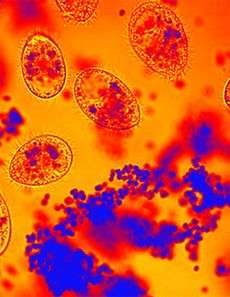
A Tetrahymena thermophila culture exposed to a moderate concentration of single-walled carbon nanotubes. The image shows the nanotubes (blue) both outside and within the protozoa.

A new study by researchers from the University of Waterloo in Ontario, Canada, hints that carbon nanotubes may be toxic to microorganisms. When cultures of a certain key protozoan, a single-cell organism, were exposed to the nanotubes their ability to ingest and digest bacteria was hindered.

The protozoan studied, Tetrahymena thermophila, lives in water, propelling itself using many arm-like cilia. The group it belongs to, the “grazing protists,” are ecologically important because they are active in water ecology at many levels.

Tetrahymena thermophila helps regulate microbial populations by ingesting and digesting bacteria. It is also an important organism in wastewater treatment and is an indicator of the quality of treated wastewater. For these reasons, it is often studied by ecotoxicologists.

When the University of Waterloo group exposed Tetrahymena thermophila to single-walled carbon nanotubes (SWNTs), the researchers found that the protozoa unnaturally clumped together initially and then ingested SWNTs and bacteria alike. One troubling effect of this, if such exposure ever occurred in the wild, is that the nanotubes could move up the food chain. In addition, because the protozoa's ability to ingest and digest their prey bacteria species is compromised, certain bacteria populations could balloon. This could have untold ecological effects.

“There is a pressing need for research into the health and environmental impact of nanoparticles,” said Xiaowu (Shirley) Tang, the study's corresponding researcher, to PhysOrg.com. Tang is an assistant professor in the University of Waterloo Department of Chemistry. “But although the importance of grazing protists to the environment and public health is well known, few reports can be found on exposure of such organisms to carbon nanotubes.”

Part of the reason for the lack of studied on carbon nanotubes effects on microorganisms is that scientists generally believe that the nanotubes are insoluble in water. However, at least one recent study challenges this belief.

With that study in mind, Tang and her colleagues exposed Tetrahymena thermophila cultures to different concentrations of nanotubes in solution and monitored them for three days using video microscopy. Besides clearly showing that the protozoa ingested the nanotubes, the video revealed that the control cultures remained healthy while the nanotube-exposed cultures exhibited various negative responses depending on the concentration. These ranged from diminished mobility to death, with the most prevalent effect being cell clumping.

“We hope that our work will stimulate a line of research towards better understanding of the effects of nanomaterials on diverse organisms, especially on single-cell organisms that are ecological important,” says Tang.

The researchers do note one potential positive effect of Tetrahymena thermophila nanotube uptake that could make controlled exposure useful in wastewater treatment: The protozoa released extra “exudates,” fluids rich in proteins and cellular debris, which help solidify impurities in the wastewater. This, in turn, could make the protozoa more efficient water-cleaners.

Citation: Parnian Ghafari, Christine H. St-Denis, Mary E. Power, Xu Jin, Veronica Tsou, Himadri S. Mandal, Niels C. Bols and Xiaowu (Shirley) Tang Nature Nanotechnology advance online publication 11 May 2008, DOI:10.1038/nnano.2008.109

Copyright 2008 PhysOrg.com.
All rights reserved. This material may not be published, broadcast, rewritten or redistributed in whole or part without the express written permission of PhysOrg.com.

Explore further: Single-cell transfection tool enables added control for biological studies

add to favorites email to friend print save as pdf

Related Stories

Rapid DNA Detection Quickly Diagnoses Infections

Oct 05, 2009

(PhysOrg.com) -- A new portable device can detect bacteria and help prevent the spread of infectious diseases. This new tool takes from 15 minutes to 2 hours to diagnose a patient for infectious diseases and ...

Recommended for you

Radioactive nanoparticles target cancer cells

May 21, 2013

Cancers of all types become most deadly when they metastasize and spread tumors throughout the body. Once cancer has reached this stage, it becomes very difficult for doctors to locate and treat the numerous tumors that can ...

How gold nanoparticles can help fight ovarian cancer

May 21, 2013

Positively charged gold nanoparticles are usually toxic to cells, but cancer cells somehow manage to avoid nanoparticle toxicity. Mayo Clinic researchers found out why, and determined how to make the nanoparticles effective ...

Advance in nanotech gene sequencing technique

May 20, 2013

(Phys.org) —The allure of personalized medicine has made new, more efficient ways of sequencing genes a top research priority. One promising technique involves reading DNA bases using changes in electrical ...

User comments : 3

Adjust slider to filter visible comments by rank

Display comments: newest first

superhuman
3.3 / 5 (3) Jun 18, 2008
I'm afraid SWNT will prove very toxic once they are thoroughly examined. Organisms don't have the ability to digest them (although they will learn it eventually if we keep introducing SWNT into environment but not any time soon)

Maybe adding charged functional groups to SWNTs could lower their toxicity as that could hinder their transport through lipid bilayer.

For them to be really safe we would have to engineer enzymes that digest SWNTs and then develop strains of common microorganisms which would be able to digest SWNTs using those enzymes. Such strains would then have to be introduced into environment. All in all a massive undertaking beyond our current capabilities and probably not even worth the effort.

In time most properties of SWNT will most likely be reproduced by molecules engineered from biocompatible materials, the only problem is that such technology is not available yet.
jcummins
1 / 5 (1) Jun 18, 2008
When reading about nano-technology I find it appalling that a scientist would use the words COULD and MAY to justify doom and gloom.
TJ_alberta
3.5 / 5 (2) Jun 18, 2008
are there any bacteria that can digest
graphite? if bacteria have not learned to digest other pure forms of carbon it could indicate the difficulty of the problem.

More news stories

Weird science: Crystals melt when they're cooled

(Phys.org) —Growing thin films out of nanoparticles in ordered, crystalline sheets, to make anything from microelectronic components to solar cells, would be a boon for materials researchers, but the physics ...

Researchers forward quest for quantum computing

Research teams from UW-Milwaukee and the University of York investigating the properties of ultra-thin films of new materials are helping bring quantum computing one step closer to reality.

Fast-acting mothers' milk for healthier babies

Human breastmilk responds quickly to protect the child when there is an infection in mothers or babies, according to new international research led by The University of Western Australia.