Radio astronomers detect 'baby quasar' near the edge of the visible Universe
June 6, 2008

Quasar J1427+3312

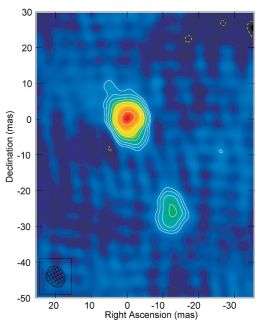
The naturally weighted 1.6-GHz VLBI image of J1427+3312 at the frequency of 1.6 GHz (18 cm wavelength). The positive contour levels increase by a factor of v2. The first contours are drawn at -50 and 50 µJy/beam (3 sigma RMS noise). The peak brightness is 460 µJy/beam. Image: JIVE.

An international group of radio astronomers has found an unexpected morphology in the most distant radio quasar ever. This was done using the world's most sensitive network of radio telescopes called the European VLBI Network (EVN). The results of their discovery are published in the Astronomy and Astrophysics journal on 5 June.

Quasars are the most powerful 'engines' in the Universe. Observed with a radio telescope they look like stars, but they are much farther away from Earth. Because they are so powerful, their light can be seen by modern telescopes from distances comparable with the size of the Universe. The observation of the newly found quasar was conducted with ten radio telescopes in Europe (including the Westerbork Synthesis Radio Telescope in the Netherlands), China and South Africa, at the frequency of 1.6 GHz (wavelength of 18 cm).

The quasar, called J1427+3312, can be seen in the image. It shows a double morphology and the components are about 480 light years apart. This kind of double morphology, combined with a steep radio spectrum, is typical for young radio sources. What makes the quasar in the picture so interesting is its extremely distant location. It is so far away from our Galaxy that it takes the light it emits more than 90% of the age of the Universe to reach us. In other words, what we see corresponds to the time when the Universe was less than 10% of its present age.

Being so distant, the quasar J1427+3312 is located relatively close to the inner edge of the so called Epoch of Reionisation (EoR) - the cosmological 'Dark Ages'. In a sense, the EoR is responsible for the appearance and composition of the Universe we live in - the variety of galaxies, stars and, ultimately, planets. The reionisation is one of the most tantalizing subjects for investigations with the next generation of radio telescopes, LOFAR and the Square Kilometre Array (SKA). Currently Dutch efforts in radio astronomy focus largely on the implementation of LOFAR and SKA.

The quasar J1427+3312, in the words of Leonid Gurvits, Senior Astronomer at the Joint Institute for VLBI in Europe (JIVE, Dwingeloo, the Netherlands), is "a powerful lighthouse that happens to be located at the place where we want to light up surroundings in search for something terribly important; one day, with new radio telescopes, we will 'use' this lighthouse as a handy tool in the search for EoR signatures."

The EVN observation that resulted in the image on the figure has become possible only owing to the impressive progress in radio astronomy technologies achieved over the last several years. "In this observation, owing to the extremely high data rate registered by all ten telescopes, we were able to achieve a sensitivity which was unthinkable just a few years ago," explains Zsolt Paragi, Senior Support Scientist at JIVE. "The combined data rate at the entry point of the EVN data processor at JIVE for this experiment was 10 Gigabit per second - an equivalent of about 1000 DVD movies played simultaneously."

Astronomers are used to intriguing sources which occupy our skies. But some sources are more wonderful than others. "In historical analogy," continues Gurvits, "finding the astronomical lighthouse J1427+3312 in such a young state at such an early cosmological epoch is like discovering one of the Seven Ancient Wonders, the Lighthouse of Alexandria, in perfect operational condition!"

The group of astronomers that discovered the quasar includes: Sándor Frey of the Satellite Geodetic Observatory, Hungary, and a former research fellow at JIVE; Gurvits; Paragi; and Krisztina Gabányi of the Institute of Space and Astronautical Sciences, Japan, and Research Group for Physical Geodesy and Geodynamics, Hungary.

Source: JIVE

4.7 /5 (33 votes)  

Filter


Move the slider to adjust rank threshold, so that you can hide some of the comments.


Display comments: newest first

googleplex
Jun 06, 2008

Rank: 3 / 5 (3)
Here is an idea.
Let's say that an inter galactic gravitational lens (or other distant heavenly body) can reflect light from our galaxy. We collect the reflected light to build an image of our own galaxy and Solar sytem. The age of the reflected light should be twice the distance in light years between our galaxy/solar system and the reflector. Thus we see an image or our galaxy and perhaps the birth of our Solar system.
Due to the weak nature of the reflected light it would need to be collected of a period of time (years) to improve the sharpness of the reflected image.
In realty some difficulties would be hard/impossible to overcome, like finding reflectors, filtering out unwanted light, compensating for motion, reconstructing an image from multiple reflectors. However it is an intriguing thought that in theory some of our own solar systems ancient photons must be reflected. In fact when we look into the sky our eye must capture some of the ancient refelected photons.
thales
Jun 06, 2008

Rank: not rated yet
I've had the very same idea, googleplex. Also, the extreme space-time curvature around a black hole would send some of the photons from our solar system back to us.
superhuman
Jun 07, 2008

Rank: 5 / 5 (1)
Me too, the idea of gravitational mirrors is pretty straightforward, but the odds of finding such a perfect mirror are infinitesimal and even if you did find it the movement of our Galaxy, Solar System and Earth in respect to the reflecting black hole would pretty soon destroy the reflection. Not to mention that to see the Earth in such a mirror Sun's light would have to first be reflected from Earth's surface and then go to the black hole and back again which would make it pretty much impossible to detect.
Rank 4.7 /5 (33 votes)
Tags

Relevant PhysicsForums posts
  • Distance of planets from stars and revolution
    created11 hours ago
  • revamping general concept and cosmological principle
    createdMay 25, 2012
  • Transiting Exoplanet Light Curve
    createdMay 25, 2012
  • Math behind Theoretical Physics
    createdMay 24, 2012
  • Do we know whats at the center of galaxies yet?
    createdMay 23, 2012
  • Structure of the Milky Way?
    createdMay 20, 2012
  • More from Physics Forums - General Astronomy

More news stories

Yale study concludes public apathy over climate change unrelated to science literacy

Are members of the public divided about climate change because they don't understand the science behind it? If Americans knew more basic science and were more proficient in technical reasoning, would public consensus match ...

Space & Earth / Environment

created 11 hours ago | popularity 4.8 / 5 (6) | comments 27 | with audio podcast

Land and sea species differ in climate change response: study

(Phys.org) -- Marine and terrestrial species will likely differ in their responses to climate warming, new research by Simon Fraser University and Australia’s University of Tasmania has found.

Space & Earth / Environment

created 9 hours ago | popularity 4 / 5 (5) | comments 6 | with audio podcast

10 million years needed to recover from mass extinction

It took some 10 million years for Earth to recover from the greatest mass extinction of all time, latest research has revealed.

Space & Earth / Earth Sciences

created 11 hours ago | popularity 4.2 / 5 (5) | comments 2 | with audio podcast

Sophisticated simulations predict future warming

The chances of our planet being hit by a global warming of 3 degrees Celsius by 2050 is as likely as it being hit by an increase of 1.4 degrees, new research shows. Presented in the journal Nature Geoscience, the British study ...

Space & Earth / Earth Sciences

created May 22, 2012 | popularity 3.8 / 5 (11) | comments 51

Kyoto Protocol architect 'frustrated' by climate dialogue

UN climate talks are going nowhere, as politicians dither or bicker while the pace of warming dangerously speeds up, one of the architects of the Kyoto Protocol told AFP.

Space & Earth / Environment

created May 23, 2012 | popularity 3.4 / 5 (8) | comments 42


'Unzipped' carbon nanotubes could help energize fuel cells, batteries

Multi-walled carbon nanotubes riddled with defects and impurities on the outside could replace some of the expensive platinum catalysts used in fuel cells and metal-air batteries, according to scientists at ...

Change in developmental timing was crucial in the evolutionary shift from dinosaurs to birds: study

At first glance, it's hard to see how a common house sparrow and a Tyrannosaurus Rex might have anything in common. After all, one is a bird that weighs less than an ounce, and the other is a dinosaur that ...

Computer model used to pinpoint prime materials for efficient carbon capture

When power plants begin capturing their carbon emissions to reduce greenhouse gases – and to most in the electric power industry, it's a question of when, not if – it will be an expensive undertaking.

T cells 'hunt' parasites like animal predators seek prey, study shows

By pairing an intimate knowledge of immune-system function with a deep understanding of statistical physics, a cross-disciplinary team at the University of Pennsylvania has arrived at a surprising finding: T cells use a movement ...

Stunning image of smallest possible five-ringed structure

Scientists have created and imaged the smallest possible five-ringed structure – about 100,000 times thinner than a human hair – and you'll probably recognise its shape.

Browser wars flare in mobile space

The browser wars are heating up again, but this time the fight is for dominance of the mobile Internet.