New details on venusian clouds revealed
May 30, 2008
New details on venusian clouds revealed
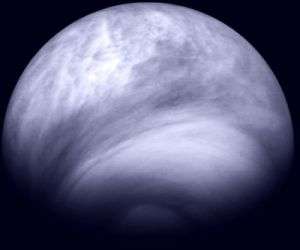
This beautiful, false-colour ultraviolet image of the Southern hemisphere of Venus was obtained by the Venus Monitoring Camera (VMC) on board ESA’s Venus Express on 27 July 2007. It was taken from a distance of 30 000 km from the planet’s surface at a wavelength of 365 nanometres. The planet is seen from the southern hemisphere: the south pole is at the bottom, while equator is at the top. Credits: ESA/MPS/DLR/IDA

As ESA's Venus Express orbits our sister planet, new images of the cloud structure of one of the most enigmatic atmospheres of the Solar System reveal brand-new details.

Venus is covered by a thick layer of clouds that extends between 45 and 70 km above the surface. These rapidly-moving clouds are mainly composed of micron-sized droplets of sulphuric acid and other aerosols (fine solid or liquid droplets suspended in a gas), the origin of which is unknown.

Earlier missions have shown that the clouds resemble Earth's light fogs, but their thickness creates an impenetrable veil.

The Venus Monitoring Camera (VMC) on board Venus Express has been observing the top of the cloud layer in visible, near-infrared and ultraviolet wavelengths. Ultraviolet observations have shown a wealth of new details including a variety of markings created by variable concentrations of different aerosols located at the top of the cloud layer.

The image presented here (top of the article) is a global view of the southern hemisphere of Venus, obtained from a distance of 30 000 km. The south pole is at the bottom, while equator is at the top.

The appearance of the cloud veil changes dramatically from the equator to the pole. At low latitudes, the shapes are spotty and fragmented. This is indicative of vigorous, convective movement – like that of boiling water in a pot – powered by the radiation of the sun heating the clouds and the atmosphere itself. The bright lace visible on top of the darker cloud deck is made of freshly formed droplets of sulphuric acid.

At mid latitudes, the scene changes – convective patterns give way to more streaky clouds indicating that convection is weaker here, as the amount of sunlight absorbed by the atmosphere decreases.

At high latitudes, the cloud structure changes again. Here it appears as a dense, almost featureless haze forming a kind of polar cap or 'hood' on Venus. The dark, circular feature visible at the lower edge of the image is one of the dark streaks usually present in the polar region, indicating atmospheric parcels spiralling around and towards the pole.

Additional images provide close-up views of the structures described above and show details never seen before. This is possible thanks to the elongated orbit of Venus Express, which allows imaging of the same phenomena from decreasing distances.

Source: ESA

Explore further: NASA's IRIS mission readies for a new challenge

add to favorites email to friend print save as pdf

Related Stories

Surprises in the South polar vortex in Venus' atmosphere

Mar 25, 2013

Spanish astronomers with the UPV/EHU's Planetary Science Group have published, online in the journal Nature Geoscience, a study of the atmospheric vortex of the south pole of Venus, a huge whirlwind the si ...

Image: Data from Venus

Dec 17, 2012

On Dec. 14, 1962, NASA's Mariner 2 spacecraft sailed close to the shrouded planet Venus, marking the first time any spacecraft had ever successfully made a close-up study of another planet. It flew by Venus ...

Chasing clouds on Venus

Oct 08, 2012

(Phys.org)—Clouds regularly punctuate Earth's blue sky, but on Venus the clouds never part, for the planet is wrapped entirely in a 20 km-thick veil of carbon dioxide and sulphuric dioxide haze.

A bad day on Venus gets even worse

Feb 29, 2012

Contrary to its alluring name, Venus is the planet from hell, with an atmosphere so hot, toxic and heavy that any visitor would risk being simultaneously melted, suffocated and crushed.

Recommended for you

Forecast for Titan: Wild weather could be ahead

3 hours ago

(Phys.org) —Saturn's moon Titan might be in for some wild weather as it heads into its spring and summer, if two new models are correct. Scientists think that as the seasons change in Titan's northern hemisphere, ...

SDO observes mid-level solar flare

3 hours ago

UPDATE 16:30 p.m. EDT: The M7-class flare was also associated with a coronal mass ejection or CME, another solar phenomenon that can send billions of tons of particles into space. While this CME was not Ea ...

NASA's IRIS mission readies for a new challenge

13 hours ago

(Phys.org) —The time draws near. NASA is getting ready to launch a new mission, a mission to observe a largely unexplored region of the solar atmosphere that powers its dynamic million-degree outer atmosphere and drives ...

User comments : 0

More news stories

Forecast for Titan: Wild weather could be ahead

(Phys.org) —Saturn's moon Titan might be in for some wild weather as it heads into its spring and summer, if two new models are correct. Scientists think that as the seasons change in Titan's northern hemisphere, ...

SDO observes mid-level solar flare

UPDATE 16:30 p.m. EDT: The M7-class flare was also associated with a coronal mass ejection or CME, another solar phenomenon that can send billions of tons of particles into space. While this CME was not Ea ...

NASA's Landsat satellite looks for a cloud-free view

For decades, Landsat satellites have documented the desiccation of the Aral Sea in Central Asia. Once one of the largest seas in the world, it shrunk to a tenth of its original volume after Russia diverted ...