Scientists announce top 10 new species, issue SOS
The International Institute for Species Exploration at Arizona State University and an international committee of taxonomists – scientists responsible for species exploration and classification – today announce the top 10 new species described in 2007.
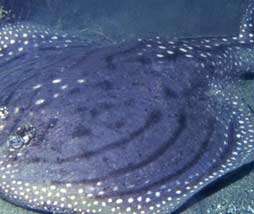
On the list are an ornate sleeper ray, with a name that sucks: Electrolux; a 75-million-year-old giant duck-billed dinosaur; a shocking pink millipede; a rare, off-the-shelf frog; one of the most venomous snakes in the world; a fruit bat; a mushroom; a jellyfish named after its victim; a life-imitates-art “Dim” rhinoceros beetle; and the “Michelin Man” plant.
The taxonomists are also issuing a SOS – State of Observed Species report card on human knowledge of Earth’s species. In it, they report that 16,969 species new to science were discovered and described in 2006. The SOS report was compiled by ASU’s International Institute for Species Exploration in partnership with the International Commission on Zoological Nomenclature, the International Plant Names Index, and Thompson Scientific, publisher of Zoological Record.
Photos and other information on the top 10 and the SOS report are online at species.asu.edu.
Among the top 10 picks is an ornate sleeper ray – Electrolux addisoni – whose name reflects “the vigorous sucking action displayed on the videotape of the feeding ray” from the east coast of South Africa that “may rival a well-known electrical device used to suck the detritus from carpets.”
Also on the list is a 75-million-year-old giant duck-billed dinosaur – Gryposaurus monumentensis – discovered in southern Utah by a team from Alf Museum, a California-based paleontology museum on a high school campus.
From the plant kingdom is the “Michelin Man™” plant – Tecticornia bibenda – a succulent plant in Western Australia that resembles the Michelin® tire man.
And, in the category of life imitating art is a “Dim” rhinoceros beetle – Megaceras briansaltini – which, according to the author, looks like the Dim character from the Disney film “A Bug’s Life.”
“The international committee of taxon experts who made the selection of the top 10 from the thousands of species described in calendar year 2007 is helping draw attention to biodiversity, the field of taxonomy, and the importance of natural history museums and botanical gardens in a fun-filled way,” says Professor Quentin Wheeler, an entomologist and director of ASU’s International Institute for Species Exploration.
“We live in an exciting time. A new generation of tools are coming online that will vastly accelerate the rate at which we are able to discover and describe species,” says Wheeler. “Most people do not realize just how incomplete our knowledge of Earth’s species is or the steady rate at which taxonomists are exploring that diversity. In 2006, for example, an average of nearly 50 species per day were discovered and named.
“We are surrounded by such an exuberance of species diversity that we too often take it for granted. Charting the species of the world and their unique attributes are essential parts of understanding the history of life and is in our own self-interest as we face the challenges of living on a rapidly changing planet,” Wheeler says.
Today’s announcements fall on the anniversary of the birth of Carolus Linnaeus, who initiated the modern system of plant and animal names and classifications. The 300th anniversary of his birth on May 23 was celebrated worldwide in 2007 and this year marks the 250th anniversary of the beginning of animal naming.
The majority of the 16,969 species described (named) in 2006 were invertebrate animals and vascular plants, which according to the SOS report is consistent with recent years and reflects, in part, “our profound ignorance of many of the most species-rich taxa inhabiting the planet.”
There are about 1.8 million species that have been described since Linnaeus initiated the modern systems for naming plants and animals in the 18th century. Scientists estimate there are between 2 million and 100 million species on Earth, though most set the number closer to 10 million.
According to the authors of the SOS report: “There are many reasons that scientists explore Earth’s species: to discover and document the results of evolutionary history; to learn the species that comprise the ecosystems upon which life on our planet depends; to establish baseline knowledge of the planet’s species and their distribution so that non-native pests and vectors of disease may be detected; to inform and enable conservation biology and resource management.
“Perhaps most compelling is curiosity about the diversity of life analogous to our quest to map the stars of the Milky Way and the contours of the ocean floor.”
The State of Observed Species report will be issued annually on May 23 by ASU’s International Institute for Species Exploration, along with the top 10 new species from the previous year.
Another element of the institute’s public awareness campaign is the co-production of a humorous video on biodiversity titled “Planet Bob,” launched on YouTube last October. The video, produced with Media Alchemy of Seattle, combines live action, state-of-the-art animation, and the vocal talents of venerable TV host Hugh Downs and others.
“The Web site www.PlanetBob.asu.edu and the video ‘Planet Bob’ represent new ways to present taxonomy and biodiversity, in a creative fusion between academia and popular technology,” says Wheeler, who also is ASU vice president and dean of the College of Liberal Arts and Sciences. The International Institute for Species Exploration was created to advance the emerging field of cybertaxonomy in partnership with leading natural history collections, engineer new cyber tools, and educate and inspire the next generation of species explorers.
Source: Arizona State University


