Come fly with me -- Bioengineers map a fly's nerves
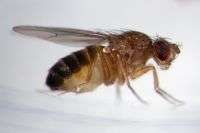
The nerve cells in a fly’s brain dedicated to analysing visual motion have been characterised in unprecedented detail by scientists.
Researchers believe the knowledge gained from understanding these simple insect nerves cells could ultimately lead to new developments in aerospace technology.
A team from Imperial College London is pushing forward their knowledge of simple insect nervous systems by charting 30 out of 60 nerve cells in a fly’s brain which are dedicated to receiving and processing information from its eyes.
Dr Holger G. Krapp, from the Department of Bioengineering, and his team have discovered that individual nerve cells in a fly’s brain are specifically designed to transmit signals which activate muscles in order to perform movements. One cell, for example, senses the turns of the insect around a vertical axis. Others help to maintain its stability by sensing rolls or the pitch of a fly in flight.
“These cells are very important for processing optical information and to control the fly’s movements. Imagine a fly is buzzing through the air and is knocked off course by a gust of wind and needs to get back on the right flight path to find food or a mate. We’ve mapped some of the brain nerve cells which would help it to process visual information and, in this scenario, help it to reflexively correct its course,” said Dr Krapp.
The discovery stemmed from the team’s observations of the electrical activity generated by the nerve cells of the back of a fly’s brain, made as the flies watched a screen which generated patterns of dots and stripes in different directions.
These patterns stimulated electrical pulses in the nerve cells which they then mapped to indicate what movement pattern each cell likes best.
Next, the team plans to investigate how nerve cells that receive information from other sensors positioned on a fly’s body help it to process information. They hope this will provide them with a more complete understanding of how flies so quickly and efficiently control their flight by combining information from different sensors.
Although the work is still ongoing the team believes its research could be used to develop new flight control systems for the next generation of super responsive jets.
“Flies are like the F22 fighter of the insect world. To control their actions they rely on thousands of sensors on their bodies including the light sensors in their eyes to send information to nerve cells. This sensory information is selectively combined in a clever way that allows specific movements to be controlled without much computational effort by the fly,” said Dr Krapp.
He adds that fighter jets require more than one supercomputer to work out their state during flight, whereas a fly uses a few dozen cells to accomplish tasks.
“I believe we could design silicon chips which mimic fly nerve cells and are individually programmed to perform specific control tasks when fed information from thousands of local sensors. This could dramatically cut down the vast amounts of processing power needed by jet fighters which could enhance their responsiveness and manoeuvrability.”
Source: Imperial College London


