Elevated concentrations of metals in China’s e-waste recycling workshops
Mar 31, 2008
Elevated concentrations of metals in China’s e-waste recycling workshops
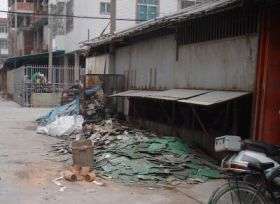
Scientists report environmental contamination from crude recycling practices after collecting dust samples near e-waste processing workshops. Above are discarded printed circuit boards outside a shop in the Beilin district of Guiyu, Guangdong Province.Courtesy of Croucher Institute for Environmental Sciences, Hong Kong Baptist University

In a case study on how not to recycle electronic waste (e-waste), scientists in the United States and Hong Kong have documented serious environmental contamination with potentially toxic metals from crude e-waste recycling in a village located in southeast China.

Recycling methods used in family-run workshops could pose a serious health risk to residents of the area through ingestion and inhalation of contaminated dust, the researchers say. Their study is scheduled for the April 15 issue of ACS’ Environmental Science & Technology.

The process of discarding computers and other consumer electronics has emerged as one of the fastest growing segments of the global waste stream. Known as e-waste, these scrapped electronic goods contain lead, copper and other hazardous materials, which can release dangerous toxins that cause air and water contamination. Up to 50-million tons of e-waste is generated worldwide each year — enough to fill a line of garbage collection trucks stretching halfway around the world — according to the United Nations Environment Program.

China is now the destination for 70 percent of the computers, TVs, cell phones, and other e-waste recycled globally each year. Ming H. Wong and colleagues collected dust samples from roads adjacent to e-waste processing workshops in Guiya, China, to find that lead levels were 330 and 371 times higher than non e-waste sites located 5 miles and 19 miles away. Copper levels were 106 and 155 times higher.

“Currently, there are no guidelines or regulations for heavy metals in dust. It is hoped that the results can serve as a case study for similar e-waste activities in countries such as Africa, India and Vietnam where e-waste is becoming a growing problem, so that the same mistakes could be prevented.”

Source: ACS

Explore further: Climate change and wildfire: Synthesis of recent findings

add to favorites email to friend print save as pdf

Related Stories

Encouraging signs for bee biodiversity

3 hours ago

Declines in the biodiversity of pollinating insects and wild plants have slowed in recent years, according to a new study. Researchers led by the University of Leeds and the Naturalis Biodiversity Centre in the Netherlands ...

NASA's BARREL mission launches 20 balloons

8 hours ago

(Phys.org) —In Antarctica in January, 2013 – the summer at the South Pole – scientists released 20 balloons, each eight stories tall, into the air to help answer an enduring space weather question: ...

Amazon plans greenhouse-style headquarters

8 hours ago

US online giant Amazon has unveiled plans for a futuristic greenhouse style headquarters "where employees can work and socialize in a more natural, park-like setting."

Recommended for you

Farmers plant rice near crippled Fukushima site

12 hours ago

Farmers have resumed planting rice for market only 15 kilometres (nine miles) from Japan's crippled Fukushima Daiichi nuclear power station, a local official said Wednesday.

Meeting the 'grand challenge' of a sustainable water supply

12 hours ago

Scientists and engineers must join together in a major new effort to educate the public and decision makers on a crisis in providing Earth's people with clean water that looms ahead in the 21st century. That's the focus of ...

Could pond waste be the 'new' fertiliser?

13 hours ago

The University of Stirling is to lead a new project to develop a strategy for using nutrient-rich aquatic biomass waste – from ponds, wetlands and other water-bodies – in farming, as an environmentally ...

Eco database to map landscape projects

14 hours ago

Environmental projects which map some of the most important benefits we get from nature have been brought together for the first time in an online database, following national survey work by researchers in the University ...

User comments : 0

More news stories

Forecast for Titan: Wild weather could be ahead

(Phys.org) —Saturn's moon Titan might be in for some wild weather as it heads into its spring and summer, if two new models are correct. Scientists think that as the seasons change in Titan's northern hemisphere, ...

SDO observes mid-level solar flare

UPDATE 16:30 p.m. EDT: The M7-class flare was also associated with a coronal mass ejection or CME, another solar phenomenon that can send billions of tons of particles into space. While this CME was not Ea ...