Energy Upgrades Pay Off for Taxpayers and Feds
Mar 05, 2008
Energy Upgrades Pay Off for Taxpayers and Feds
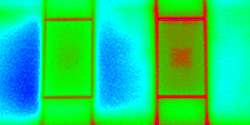
Infrared image of the outside wall of the control and test rooms. The test room, on the left, has undergone modifications. Its image shows significantly more blue (a colder temperature, less heat loss). The unmodified control room on the right shows little blue and much more green, orange and red colors that represent the warm air escaping to the outside. Credit: NIST

Buildings account for 40 percent of the energy consumed within the United States and a similar percentage of carbon dioxide emissions. National Institute of Standards and Technology engineers recently took a look at energy-related upgrades to their own quarters—and found energy-related improvements were well worth the expense. A NIST plan to act on the findings should save taxpayers money while helping meet a presidential order for federal agencies to cut energy consumption to 70 percent of 2003 levels by 2015.

The NIST researchers undertook their study using two adjacent offices in one of the general purpose buildings on the NIST campus. The building is typical of those constructed on the NIST campus in the early to mid-1960s.

One of the two offices served as the control office and the second office was modified to reduce the flow of energy through the exterior wall. Each room was carefully instrumented to determine energy savings that could be realized through various energy savings options while maintaining identical levels of comfort.

The unmodified control office has a single-pane glass window unit and an antiquated heating and cooling unit. Thermal insulation was not present between the exterior walls of the office and the interior space. Significant air leakage occurred between the interior of the office and the outdoor air as a result of numerous gaps and voids in the exterior wall.

In the modified office all air leaks were sealed The exterior walls were insulated with approximately 9 inches of glass-fiber insulation and the more than 40-year-old single-pane glass window was replaced with a double-pane, argon-filled insulated glass window unit. A forced air heating and cooling unit was installed in the attic to deliver conditioned air to the office module, replacing the antiquated heating and cooling system that required piping in the office module walls. Energy upgrade expenditures came to approximately $2,825.

Measurements made to compare the energy required to maintain the control and modified office modules at identical conditions revealed a 59 percent savings. Annual cost savings from the energy upgrades, based on 2007 energy prices, came to approximately $195 per year. The researchers used NIST’s Cost Effectiveness Tool for Capital Asset Protection software to figure in a three percent annual energy price escalation rate. They found that over a 25-year period the improvements would generate an average $1.75 for each dollar invested.

NIST will begin implementing the research findings in April. In the first phase 22 offices will be upgraded with the energy savings features. The remaining 85 offices will be modified in 2009 and 2010.

Source: NIST

Explore further: Taking stock of technology

add to favorites email to friend print save as pdf

Related Stories

NIST's speedy ions could add zip to quantum computers

Aug 09, 2012

(Phys.org) -- Take that, sports cars! Physicists at the National Institute of Standards and Technology (NIST) can accelerate their beryllium ions from zero to 100 miles per hour and stop them in just a few microseconds. What's ...

Giant piezoelectric effect to improve MEMS devices

Dec 02, 2011

Researchers in the Department of Materials Science and Engineering and the Materials Research Institute at Penn State are part of a multidisciplinary team of researchers from universities and national laboratories ...

Proposed U.S. budget cuts target science

Mar 08, 2011

A "Sputnik moment" or a "kaputnik" one for U.S. science? With a federal budget battle showdown under way, science looks like collateral damage, say former federal officials, with proposed cuts to research that they consider ...

Recommended for you

Prehistoric rock art maps cosmological belief

6 hours ago

It is likely some of the most widespread and oldest art in the United States. Pieces of rock art dot the Appalachian Mountains, and research by University of Tennessee, Knoxville, anthropology professor Jan ...

'Ugly' finding: Unattractive workers suffer more

8 hours ago

People who are considered unattractive are more likely to be belittled and bullied in the workplace, according to a first-of-its-kind study led by a Michigan State University business scholar.

Taking stock of technology

9 hours ago

At the recent Harvard IT Summit, Anne Margulies, vice president and University chief information officer, mentioned how Harvard had been at the forefront of information technology since its inception, even to the point of ...

Gay marriage ruling unlikely to cause anti-gay backlash

10 hours ago

Concerns that a U.S. Supreme Court ruling favorable to gay marriage might produce a backlash that would impede efforts to achieve equality are unfounded, according to a study by researchers at University of California campuses ...

User comments : 0

More news stories

Prehistoric rock art maps cosmological belief

It is likely some of the most widespread and oldest art in the United States. Pieces of rock art dot the Appalachian Mountains, and research by University of Tennessee, Knoxville, anthropology professor Jan ...

'Ugly' finding: Unattractive workers suffer more

People who are considered unattractive are more likely to be belittled and bullied in the workplace, according to a first-of-its-kind study led by a Michigan State University business scholar.

Gay marriage ruling unlikely to cause anti-gay backlash

Concerns that a U.S. Supreme Court ruling favorable to gay marriage might produce a backlash that would impede efforts to achieve equality are unfounded, according to a study by researchers at University of California campuses ...