UT Southwestern plastic surgeons deploy new carbon dioxide-based fractional laser
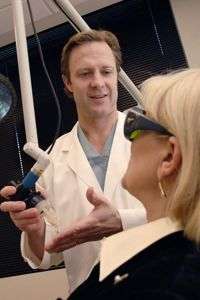
UT Southwestern Medical Center plastic surgeons are among a handful in the nation deploying a new type of laser that goes deeper into the skin to help reduce wrinkles, tighten surface structures and treat pigmentation differences.
UT Southwestern was one of only two U.S. centers to receive the Food and Drug Administration-approved laser for initial testing before making it available for patients. Plastic surgeons at UT Southwestern have completed testing and are now starting to use the new carbon dioxide-based fractional laser, which combines minute focused columns of laser-induced injury with heat deposition for less skin damage and quicker recovery time.
“Fractional lasers are like aerating your lawn, where you have a bunch of holes in your lawn, but you have normal lawn in between. This allows for more rapid healing because intact, normal skin bridges the gap between the laser-induced injured skin,” said Dr. Jeffrey Kenkel, vice chairman of plastic surgery whose research involves the effects of lasers on tissue. “We can vary the distance between the holes, which has an effect on how much tissue we choose to treat. The treatment parameters are determined by what we are trying to accomplish for each of our patients.”
Dr. Kenkel, director of the Clinical Center for Cosmetic Laser Treatment and chief of plastic surgery at the Veterans Administration Medical Center at Dallas, said the technology potentially could be one of the last decade’s biggest advancements in the laser world.
“What’s appealing about carbon dioxide lasers is that not only can you get surface and deeper skin changes, but you get heat that’s deposited into the skin resulting in improvement in wrinkles and skin tightening,” said Dr. Kenkel.
“There are lots of new lasers that come out on the market. We take a scientific approach when investigating new laser devices. We evaluate the laser on tissue that has either been removed from patients or that we plan on removing so we can determine what effect it’s going to have before we start treating patients clinically.”
With more than 200 lasers on hand for various procedures, UT Southwestern is one of the world’s leaders in providing patients with laser treatment options. This latest model, made by California-based Lumenous Device Technologies, has a large arm and two heads and can be used on a variety of conditions, including wrinkle removal, acne scarring, alleviating dark pigmentation, and other conditions that the plastic surgery group is investigating.
Early carbon dioxide-based lasers were popular in the early 1990s, but faded from favor due to long recovery periods – sometimes spanning several months – and pigmentation inequities that resulted in loss of pigmentation in the patient’s skin after treatment.
The new laser treatments are office-based procedures done on an out-patient basis, but may require some local or regional anesthetic, with recovery time related to the type of procedure. In most instances recovery is between three and five days. Depending on what’s required, procedure costs can range from $500 to $3,000 and are usually considered cosmetic.
The popularity of out-patient, office-based laser procedures has been rising as lasers have improved.
“There are a lot of patients who would rather not have surgery and who are looking for things to improve their appearance without surgical down time,” Dr. Kenkel said. “In addition, there’s a whole group of younger patients who are looking for improvement who are not necessarily in need of surgery but perhaps would benefit from some of the lesser invasive procedures that we have to offer.”
Americans spent more than $12 billion last year on cosmetic procedures, involving 11.5 million surgical and nonsurgical procedures, according to the American Society for Aesthetic Plastic Surgery. Nonsurgical procedures, which include laser treatments, accounted for about 83 percent of those procedures.
Source: UT Southwestern Medical Center


