As a river runs through it, a Death Valley stream offers insights into flooding and climate change
Death Valley may be known by its three superlatives: hottest, driest, and lowest – as in temperature, rainfall, and elevation in the United States. But it was the flow of water through the National Park that attracted Boston College Geologist Noah P. Snyder to the desert of eastern California.
In one of the few places where rivers do not flow to the sea, Snyder’s research into a 1941 stream diversion in the historic park uncovered a rare glimpse into a range of geological changes that might otherwise take centuries to unfold but instead are revealed following the flashfloods that strike the park, located against the Nevada border.
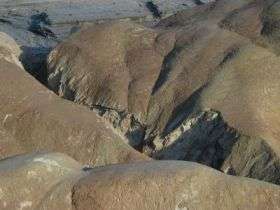
Furnace Creek Wash, diverted to protect a village from flooding during infrequent but powerful rainstorms, has carved through Gower Gulch over the years. The way the creek cuts through the sandy hills highlights the effects original landscape and changing channel dynamics exert on the responses of diverted rivers and streams, according to research by Snyder, published in February edition of the journal Geology.
“This is an unusual opportunity to see how a river system responds to an extreme change in the historic rates of water and sediment flow,” said Snyder, who co-authored the paper with former graduate student Lisa R. Kammer ‘05. “It’s a hot topic in the earth sciences where we’re interested in learning more about the interaction of climate change, tectonics and bedrock erosion.”
In response to the diversion, Snyder found the Furnace Creek produced an unusual hybrid of consequences: at some points, the creek cuts into the land, leaving deep slices in the bedrock from the surge of flood waters brought on by as little as a half-inch to an inch of rain falling over the watershed that rolls out of the Funeral Mountains. At other points, where soft, sedimentary rocks sit below the surface, the creek has had a widening effect on its channel. These changes are brought on by periodic storms, not the steady flow of a routinely-fed creek or river, giving Snyder a chance to document this combination of effects at work.
Geologists have established models to predict the responses of channels, particularly bedrock rivers, Snyder said. Until he decided to investigate Gower Gulch, there had been few natural experiments to allow geologists to test and validate the models.
Snyder, who presented some of his findings in December at the annual meeting of the American Geophysical Union, specializes in river habitat restoration and lends his expertise to a number of dam removal projects throughout New England. He said he was drawn to Gower Gulch because of the unique opportunity to measure effects that mimic the impact of climate change on river flooding and erosion.
His research included a field study in the park in 2005, a review of aerial photographs taken between 1948 and 1995, as well as laser-guided elevation data provided by the National Center for Airborne Laser Mapping.
A geological wonder known for its searing summer-time temperatures, Death Valley sits nearly 300 feet below sea level, making it one of the few sites in the U.S. where rivers do not flow to the sea. A small dam and an opening blasted by engineers in 1941 now send Furnace Creek Wash rushing through Gower Gulch before emptying into the valley floor. Gower Gulch, dominated by sculpted sedimentary rock reminiscent of the rutted landscape of the Badlands of South Dakota, was photographed after the diversion by the late naturalist and photographer Ansel Adams.
The creek was diverted to prevent the flooding of a small village, but the National Park continues to sustain damage when heavy rains deluge the region. A flash flood in 2006 swept away vehicles, washed out roads and undermined visitor facilities at the Zabriskie Point look-out, according to park service reports.
Snyder said he does not expect any efforts to return Furnace Creek Wash to its original state because that would probably require relocation of the National Park Service village downstream. But the activity in Gower Gulch provides almost a time-lapse view into the effects of water flow. Under normal conditions, the effects of rivers and streams take eons to clearly manifest themselves in the land. But the man-made diversion, coupled with the intermittent flow of the creek through Gower Gulch has produced a microcosm of geological activity for Snyder and other scientists to observe, Snyder said.
Source: Boston College


