New map of the Milky Way charts where stars are born
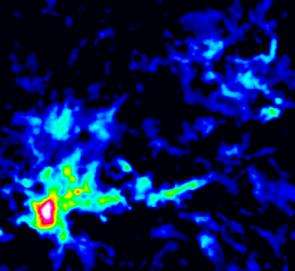
A team of astronomers from Boston University's Institute for Astrophysical Research has produced the clearest map to-date of the giant gas clouds in the Milky Way that serve as the birthplaces of stars. Using a powerful telescope, the astronomers tracked emissions of a rare form of carbon monoxide called 13CO to chart a portion of our home galaxy and its star-forming molecular clouds.
The researchers hope the new illustration will aid in the identification of additional clouds and study of their internal structure to better understand the origin of stars like the sun, which began its life in such a cloud about 5 billion years ago. The data and images are published in the March issue of the Astrophysical Journal Supplement.
The eight-year project, called the Boston University-Five College Radio Astronomy Observatory (FCRAO) Galactic Ring Survey (GRS), was led by a team of astronomers based at BU, the University of Cologne in Germany, and the University of Massachusetts. To produce the detailed image, the astronomers mapped the location of 13CO in the Milky Way using a large radio telescope operated by the FCRAO of the University of Massachusetts that captures and images radio emissions at a frequency near 100,000 MHz – about 1,000 times higher than FM stations. When viewed in the emission from 13CO, the clouds are far more transparent than the more traditionally studied 12CO which allowed the team to peer more deeply into their interior.
"The value of such high range imaging is that it enables us to identify the underlying patterns of gas distribution and speeds that point toward the key physical processes occurring within the molecular gas phase of the interstellar medium," said Dr. Mark Heyer, a researcher from UMass involved in the project.
Using a new receiver, the astronomers could depict the structure of the clouds faster and with much finer detail than any previous attempts. As an added benefit, the distribution of the clouds also delineates the spiral structure of the Milky Way.
"Ironically, because we live inside the Milky Way, we know more about the shapes of far more distant galaxies better than our own," said James Jackson, astronomy professor at BU and lead investigator of the study. "The GRS map helps us better understand the configuration of our home galaxy and its components."
"Upon seeing the GRS image, I knew right away it was something terrific. It was like the first time I put on glasses as a kid, and wondered how I ever got along without knowing about every shape, contour and detail of the world around me," said Dr. Ronak Shah, a researcher from BU who worked on the project. "The GRS has that affect on a lot of us. We thought we understood the Milky Way and then the GRS revealed so much more detail to explore."
According to Dr. Robert Simon, now at the University of Cologne, but who started the project with Jackson in 1998 at BU, the information from the GRS will constitute an important new data base for the study of molecular clouds and Milky Way structure for generations of astronomers.
The scientists are now closely analyzing the image and one of the initial findings is the probable identification of dark, cold molecular clouds in the earliest stages of star development.
"Data from the Galactic Ring Survey have shown that these clouds are the counterparts to active, bright star-forming clouds, but because they have not yet been heated by the embedded stars, they are much colder and quieter," said Jackson. "Follow-up studies of these clouds will provide additional important clues about the origin of stars since we'll be able to examine them at an earlier point in their life."
Another interesting result is that all of the molecular clouds studied so far have similar lumpy structures, regardless of their size, mass, and star-forming activity. These lumps will eventually become stars and, according to the researchers, this similarity suggests that all clouds form stars of various masses in roughly the same proportion.
The Milky Way is a vast disk of 100 billion stars, gas, and dust and because it is flat, the map is long and narrow. Since most of the galaxy lies in the Southern skies, unreachable from northern hemisphere telescopes, and because many of the molecular gas clouds are concentrated toward its inner regions, only a portion was imaged.
Source: Boston University


