Antarctic Ice Loss

Jan 13, 2008
Satelite Image of Ice Loss
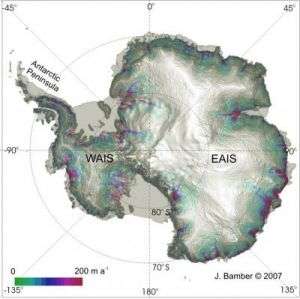
Satellite-derived image of the surface topography of Antarctica. Shown in color are the flow speeds of glaciers draining ice into the oceans. The scale is meters per year. It is noticeable how the rate speeds up in narrow glacier outlets. Credit: Jonathan Bamber

Increasing amounts of ice mass have been lost from West Antarctica and the Antarctic peninsula over the past ten years, according to research from the University of Bristol and published online this week in Nature Geoscience.

Meanwhile the ice mass in East Antarctica has been roughly stable, with neither loss nor accumulation over the past decade.

Professor Jonathan Bamber at the University of Bristol and colleagues estimated the flux of ice from the ice sheet into the ocean from satellite data that cover 85% of Antarctica's coastline, which they compared with simulations of snow accumulation over the same period, obtained using a regional climate model.

They arrived at a best estimate of a loss of 132 billion tonnes of ice in 2006 from West Antarctica – up from about 83 billion tonnes in 1996 – and a loss of about 60 billion tonnes in 2006 from the Antarctic Peninsula.

Professor Bamber said: “To put these figures into perspective, four billion tons of ice is enough to provide drinking water for the whole of the UK population for one year."

The authors conclude that the Antarctic ice sheet mass budget is more complex than indicated by the evolution of its surface mass balance or climate-driven predictions.

Changes in glacier dynamics are significant and may in fact dominate the ice sheet mass budget. This conclusion is contrary to model simulations of the response of the ice sheet to future climate change, which conclude that it will grow due to increased snowfall.

The ice loss is concentrated at narrow glacier outlets with accelerating ice flow, which suggests that glacier flow has altered the mass balance of the entire ice sheet.

Over the 10 year time period of the survey, the ice sheet as a whole was certainly losing mass, and the mass loss increased by 75% during this time. Most of the mass loss is from the Amundsen Sea sector of West Antarctica and the northern tip of the Peninsula where it is driven by ongoing, pronounced glacier acceleration. In East Antarctica, the mass balance is near zero, but the thinning of its potentially vulnerable marine sectors suggests this may change in the near future.

Source: University of Bristol

Explore further: Astonishing hi-resolution satellite views of the destruction from the Moore, Oklahoma tornado

add to favorites email to friend print save as pdf

Related Stories

Recommended for you

Strong earthquake at exceptional depth

23 hours ago

This morning at 05:45 CEST, the earth trembled beneath the Okhotsk Sea in the Pacific Northwest. The quake, with a magnitude of 8.2, took place at an exceptional depth of 605 kilometers. Because of the great ...

Marine forecasting on the horizon for Indian Ocean Rim

23 hours ago

Nearly all of the member countries of the Indian Ocean Rim Association for Regional Cooperation (IOR-ARC) will attend the week-long workshop to further cooperation and understanding on international ocean ...

Russia evacuates drifting Arctic research station

May 23, 2013

Russia has ordered the urgent evacuation of the 16-strong crew of a drifting Arctic research station after ice floe that hosts the floating laboratory began to disintegrate, officials said Thursday.

User comments : 1

Adjust slider to filter visible comments by rank

Display comments: newest first

NotParker
2.3 / 5 (3) Jan 14, 2008
"While the news focus has been on the lowest ice extent since satellite monitoring began in 1979 for the Arctic, the Southern Hemisphere (Antarctica) has quietly set a new record for most ice extent since 1979.

This can be seen on this graphic from this University of Illinois site The Cryosphere Today, which updated snow and ice extent for both hemispheres daily. The Southern Hemispheric areal coverage is the highest in the satellite record, just beating out 1995, 2001, 2005 and 2006. Since 1979, the trend has been up for the total Antarctic ice extent."

http://icecap.us/...e_extent

More news stories

Galaxies fed by funnels of fuel

(Phys.org) —Computer simulations of galaxies growing over billions of years have revealed a likely scenario for how they feed: a cosmic version of swirly straws.

Source of life running out: water scientists

The majority of people on Earth people will face severe water shortages within a generation or two if pollution and waste continues unabated, scientists warned at a conference in Bonn Friday.

Dark, massive asteroid to fly by Earth on May 31

It's 1.7 miles long. Its surface is covered in a sticky black substance similar to the gunk at the bottom of a barbecue. If it impacted Earth it would probably result in global extinction. Good thing it is ...

Yahoo, pay-TV operators among Hulu bidders

Online video site Hulu is again up for sale, with Yahoo and pay TV operators DirecTV and Time Warner Cable among the seven bidders, according to a person with direct knowledge of the matter.

Heart failure accelerates male 'menopause'

Heart failure accelerates the aging process and brings on early andropausal syndrome (AS), according to research presented today at the Heart Failure Congress 2013. AS, also referred to as male 'menopause', was four times ...

Radiation leak at Japan lab; small impact expected

An atomic research lab in northern Japan has reported a radiation leak that may have affected about 50 people, though none were hospitalized and no impact was expected outside the facility, the lab's operator ...

Feds fight morning-after pill age ruling in NY

(AP)—Department of Justice lawyers have again asked a federal appeals court in New York to delay lifting age restrictions and prescription requirements on an emergency contraceptive popularly known as the morning-after ...