Crash warning for connected cars?
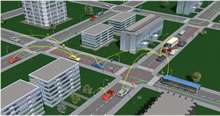
European researchers have demonstrated in the lab a collision warning system for cars that could alert the driver several seconds in advance of an imminent impact. The device could save thousands of lives and usher in the first steps towards the ‘connected car’.
It knows its location, can talk to other cars and can tell the future. Are we entering the era of truly automated cars? The Collision Warning System (CWS) is the brainchild of the Reposit project, and they recently fired up a fully working prototype of their system.
The prototype can find its position using GPS, and find the position, speed and trajectory of neighbouring and oncoming traffic using an emerging car communication protocol called Vehicle2Vehicle (V2V).
It can use that information to calculate the relative position of other cars, and then extrapolate where they will be in a few seconds’ time. If the data predicts a collision, it warns the driver.
“So far, we’ve got predictions about 1 to 3 seconds ahead of a collision… but anything from 2 seconds up gives drivers time to react. It works better at medium-to-high speeds, above 50km/h,” reveals Jose Ignacio Herrero Zarzosa, coordinator of the Reposit ‘relative position for collision avoidance systems’ project.
High-performance GPS systems, that can locate a car within a metre or so, perform far better than low-performance GPS systems, but even with poor GPS technology Reposit has managed to get warning times to 1.5 seconds in a simulator, not too far from the useful minimum of 2 seconds. Zarzosa believes the system can do even better, with further work using vehicles’ available sensors.
But the system does work, at least in a simulator, and that is a concrete result. The team has also perfected a simulator that other projects can use to model car collisions, another useful output. But will it be a success?
Unforgiving economics
It is possible, in time. Crucially, the system uses technologies, such as GPS and V2V, which are already becoming common or are emerging as a feature of modern cars. More and more cars come with GPS already installed, explains Zarzosa, and many owners are self-installing a GPS system, so for these cars Reposit takes advantage of the installed base.
V2V is an emerging standard for communication between vehicles, and so it will become more common as time goes by. The Rosetta stone of the system, the programme that ties all the devices together, is just software and so relatively cheap.
That is very important. Keeping cost down is essential for any new car technology. The economics of the motor industry are unforgiving. “New car devices must be cheap if they are to be commercialised,” notes Zarzosa.
The Reposit team discovered that the rules for automobile innovation are unforgiving, too. Right now, there is no standard for integrating new functions into an existing car system. Every manufacturer uses different system integration methods. This significantly pushes up the cost of third-party technologies like Reposit,” warns Zarzosa.
Although the European Commission reports that it is working hard on this.
So far, the car industry finds Reposit’s work interesting, but remains unconvinced of the commercial application. The car industry is... very price sensitive, notes Zarzosa.
Even so, the popularity of GPS, and the emergence of V2V as a standard, means that the system will become more attractive over time. Before long, drivers might take the first, tentative steps into the era of connected cars.
Source: ICT Results


