Some 20,000 soldiers a year may be trained with Sandia-enhanced simulation video game
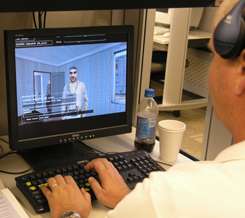
Some 20,000 soldiers a year may soon be trained in interpersonal skill building and cross-cultural awareness using a videogame recently developed by researchers from Sandia and BBN Technologies.
Funded through Defense Advanced Research Projects Agency (DARPA), the nine-month project resulted in the instantiation of Sandia’s adaptive thinking training methodology that prepares warfighters for difficult situations in places such as Afghanistan and Iraq, says project lead and scientist Elaine Raybourn.
“We are talking about training for nonkinetic engagement — interpersonal communication, negotiation skills, and interpersonal rapport,” she says. “The goal is to make soldiers better thinkers and communicators under stress.”
Raybourn and her team recently delivered DARPA’s “DARWARS Ambush NK!” to the Program Executive Office for Simulation, Training, and Instrumentation (PEO-STRI), which will distribute the enhanced system to the Army and eventually the other armed forces.
The training tool is conceptually similar to an earlier multiplayer simulation game she developed several years ago. That same game is currently used by members of the U.S. Army Special Forces to hone their skills in adaptive thinking, negotiation, conflict resolution, and leadership in cross-cultural settings. The Special Forces’ game is being used to train soldiers on a regular basis at Ft. Bragg in North Carolina.
Like the first game, the new one developed for DARPA will allow as many as 64 people to play on networked computers. Instructors can easily modify or create scenarios, monitor training, and jump in and change the direction of the game at any time.
Participants serve as either role-players or evaluators. Their tasks and experiences vary according to their role.
Raybourn says DARPA came to her seeking help in building the new game after it became aware of the one she developed for the U.S. Army Special Forces. DARPA already had a training game in the works designed by BBN Technologies. That game had a strong kinetic focus on physical aspects that could go wrong, such as improvised explosive devices going off or a convoy being ambushed.
“DARPA also wanted a nonkinetic adaptive thinking piece for the soldiers, to learn how to negotiate with tribal leaders, for example,” Raybourn says. “When things go wrong, troops have to learn to shift how they think in environments that are potentially dangerous.”
A major enhancement made by Raybourn to the existing DARPA system was the addition of a peer/expert evaluation element, she says.
“I found Raybourn’s idea of using a set of soldiers as observers and assessors particularly innovative and hope the Army can adopt it with its digital training tools,” says Ralph Chatham, former DARPA program manager who selected Raybourn to work on the project. “The Army is the only big organization in the world that has institutionalized introspection in their after-action review process [AAR]. Sergeants can talk back to lieutenants in an AAR, and both are pleased with the process. That part of the ATL [Adaptive Thinking and Leadership] simulation game Raybourn and the team produced fits the Army perfectly.”
Raybourn estimates that the number of people who could be trained with the DARPA-sponsored game could be “extensive—reaching soldiers in the U.S. and overseas.” PEO-STRI is putting the nonkinetic modules on its website where it will be available free to all U.S. military services, federal law enforcement, and government.
The nonkinetic modules are comprised of a socio-cultural overlay for a geographical area that is linked to key events and roles of host nation civilians.
Team members who contributed to designing the roles include subject-matter experts from the Fort Lewis Battle Command Training Center in Fort Lewis, Wash.; Pravin Rajan, a former Sandia employee and current U.S. Marine; and Alan Rolli, former U.S. Army and former Sandia employee.
Raybourn says that creating a serious game is “truly a collaborative effort that often involves pulling together a distributed, virtual team of industry, military, and government partners, just to name a few.” Game design teams often represent diverse cultural orientations and face the same communication challenges encountered by trainees.
“We hope this training will help soldiers better understand the cultural environments they are exposed to and better handle difficult situations,” Raybourn says.
Source: Sandia National Laboratory


