New geosciences model explains ocean formation
Scientists at The University of Texas at Austin’s Jackson School of Geosciences and the Université Louis Pasteur in Strasbourg, France, have developed a new model to explain how continents break apart to form new oceans. Their discovery may improve targeting of deep-water oil and gas reserves. A description of the model appears in the March 16 edition of Nature.
Luc Lavier, a research associate at Jackson School’s Institute for Geophysics, and Gianreto Manatschal, a professor of tectonics at the Université Louis Pasteur, set out to understand inconsistencies in the way that tectonic models account for the geology of deep-water ocean basins.
In the process, they developed a new model that expands geologic theory. The energy industry can also use the model to locate hydrocarbons in deep water.
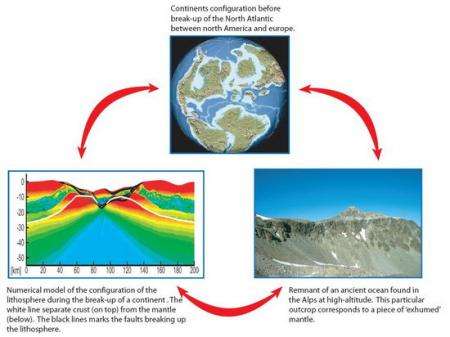
Deep-water oil and gas reserves are notoriously difficult to pinpoint. The new model could make it more affordable to explore for potential reserves in the Gulf of Mexico, coastal West Africa and other deep-water regions.
The model derived from experiments and geological reconstructions of the evolution of the ancient Alpine and present-day North Atlantic margins.
“In recent years, academic and petroleum industry studies of continental margins have shown that their evolution is more complex than that predicted by earlier models,” said Lavier. Energy companies have been especially interested in learning more about the evolution of continental margins, he said, because “the old models were not working.”
The two prevailing models explaining continental break-up are known as pure shear and simple shear. Both seek to explain how the Earth’s outer layers-the upper crust and underlying mantle, together known as the lithosphere-stretch and deform in a process that breaks apart continents.
The pure and simple shear models explain features observed near the coasts of continents but fail to explain the geology of the deep oceans. In particular, pure and simple shear models do not do adequately predict a process called mantle melting, which forms the volcanic seafloor in deep oceans.
Lavier and Manatschal propose a new model that can explain both mantle melting in deep waters and phenomena observed at the edge of continental margins. In their model, a single fault in the Earth’s crust and a single fault in the mantle work in tandem to thin the Earth’s top two layers and uplift the mantle. These faults behave like a conveyor belt pulling up lower crust and mantle.
Geologists have long observed the products of this process in nature. Remnants of ancient oceans that have been discovered at high altitudes in mountain ranges like the Alps and the Rockies narrate the story of the break up of continents and the formation of new oceans.
“Our model represents a shift in the way we understand the evolution of deformation and Earth’s material properties during extension of the continental lithosphere,” said Lavier.
The new model also revises the concept of how heat is distributed in offshore sedimentary basins that contain the world’s major deep-water reserves of oil and gas. Geologists use the temperature history of sediments to predict where oil and gas is located. Refining the ability to assess temperature history “is critical in areas such as the south Atlantic where oil exploration is taking place in deeper waters in the search for future resources,” said Lavier.
The researchers’ next steps are to go back to the field and look for geological features that the model predicts. Lavier is applying the model to other geological settings like the San Andreas Fault in California.
Supercomputers at the Jackson School’s Institute for Geophysics helped run the model, which benefited from advances over the last decade in computing and the application of algorithms for material deformation to geology.
The research was supported in part by ExxonMobil Upstream Research Company and Groupe de Recherche des Marges, a French academic consortium co-sponsored by Total Oil Company.
Source: University of Texas at Austin


