Scientists work toward engineered blood vessels
Dec 17, 2007
Scientists work toward engineered blood vessels
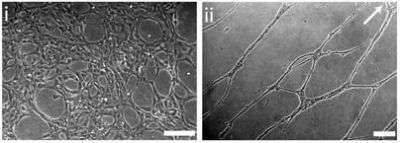
When a gel that induces tube formation is added to the cells, the cells grown on a nanopatterned surface form tubes aligned in the same direction (right). Cells grown on a flat surface form tubes extending in many directions (left). Images / Christopher Bettinger

MIT scientists have found a way to induce cells to form parallel tube-like structures that could one day serve as tiny engineered blood vessels.

The researchers found that they can control the cells' development by growing them on a surface with nano-scale patterning. A paper on the work was posted this month in an online issue of Advanced Materials.

Engineered blood vessels could one day be transplanted into tissues such as the kidneys, liver, heart or any other organs that require large amounts of vascular tissue, which moves nutrients, gases and waste to and from cells.

"We are very excited about this work,” said Robert Langer, MIT Institute Professor and an author of the paper. “It provides a new way to create nano-based systems with what we hope will provide a novel way to someday engineer tissues in the human body.”

The work focuses on vascular tissue, which includes capillaries, the tiniest blood vessels, and is an important part of the circulatory system. The team has created a surface that can serve as a template to grow capillary tubes aligned in a specific direction.

The researchers built their template using microfabrication machinery at Draper Laboratory in Cambridge. Normally such technology is used to build micro-scale devices, but the researchers adapted it to create nano-scale patterns on a silicone elastomer substrate. The surface is patterned with ridges and grooves that guide the cells' growth.

“The cells can sense (the patterns), and they end up elongated in the direction of those grooves,” said Christopher Bettinger, MIT graduate student in materials science and engineering and lead author of the paper.

The cells, known as endothelial progenitor cells (EPCs), not only elongate in the direction of the grooves, but also align themselves along the grooves. That results in a multicellular structure with defined edges, also called a band structure.

Once the band structures form, the researchers apply a commonly used gel that induces cells to form three-dimensional tubes. Unlike cells grown on a flat surface, which form a network of capillary tubes extending in random directions, cells grown on the nano-patterned surface form capillaries aligned in the direction chosen by the researchers.

The researchers believe the technique works best with EPCs because they are relatively immature cells. Earlier attempts with other types of cells, including mature epithelial cells, did not produce band structures.

Growing tissue on a patterned surface allows researchers a much greater degree of control over the results than the classic tissue engineering technique of mixing cell types with different growth factors and hoping that a useful type of tissue is produced, said Bettinger.

“With this technique, we can take the guesswork out of it,” he said.

The next step is to implant capillary tubes grown in the lab into tissues of living animals and try to integrate them into the tissues.

Source: Massachusetts Institute of Technology

Explore further: Sweet solutions for detecting disease

add to favorites email to friend print save as pdf

Related Stories

The science of sculpture, nano-style

Jun 14, 2013

(Phys.org) —The next breakthrough in highly efficient battery technologies and solar cells may very well be nanoscopic crystals of silicon assembled like skyscrapers on wafer-scale substrates. An important ...

Purifying dairy wastewater while producing electricity

Jun 14, 2013

In an EU-funded project the Fraunhofer Institute for Interfacial Engineering and Biotechnology IGB in Stuttgart is developing, together with industrial and scientific partners, a modular system to purify dairy wastewater ...

Recommended for you

An environmentally friendly battery made from wood

2 hours ago

Taking inspiration from trees, scientists have developed a battery made from a sliver of wood coated with tin that shows promise for becoming a tiny, long-lasting, efficient and environmentally friendly energy ...

Sound waves precisely position nanowires

2 hours ago

(Phys.org) —The smaller components become, the more difficult it is to create patterns in an economical and reproducible way, according to an interdisciplinary team of Penn State researchers who, using ...

Sweet solutions for detecting disease

4 hours ago

Based at the Institute of Chemistry in the Slovak Academy of Sciences, Ján Tkáč's research combines glycomics – the study of sugars in organisms – with biochip sensors based on nanoparticles and nanotubes. ...

Hybrid nanostructures: Getting to the core

4 hours ago

Material scientists expect the new multifunctional properties of hybrid nanostructures will transform the development of high-performance devices, including batteries, high-sensitivity sensors and solar cells. ...

3D printing tiny batteries

21 hours ago

(Phys.org) —3D printing can now be used to print lithium-ion microbatteries the size of a grain of sand. The printed microbatteries could supply electricity to tiny devices in fields from medicine to communications, ...

User comments : 1

Adjust slider to filter visible comments by rank

Display comments: newest first

quantum_flux
5 / 5 (1) Dec 17, 2007
Brilliant! That is quite ingenious. Elderly people and people with poor blood circulation could definately benifit from artificial capillaries.

More news stories

Sound waves precisely position nanowires

(Phys.org) —The smaller components become, the more difficult it is to create patterns in an economical and reproducible way, according to an interdisciplinary team of Penn State researchers who, using ...

An environmentally friendly battery made from wood

Taking inspiration from trees, scientists have developed a battery made from a sliver of wood coated with tin that shows promise for becoming a tiny, long-lasting, efficient and environmentally friendly energy ...

3D printing tiny batteries

(Phys.org) —3D printing can now be used to print lithium-ion microbatteries the size of a grain of sand. The printed microbatteries could supply electricity to tiny devices in fields from medicine to communications, ...

Hybrid nanostructures: Getting to the core

Material scientists expect the new multifunctional properties of hybrid nanostructures will transform the development of high-performance devices, including batteries, high-sensitivity sensors and solar cells. ...

Antioxidant shows promise in Parkinson's disease

Diapocynin, a synthetic molecule derived from a naturally occurring compound (apocynin), has been found to protect neurobehavioral function in mice with Parkinson's Disease symptoms by preventing deficits in motor coordination.

Paralysed with fear: The story of polio

Thanks to vaccination, polio has been pushed to the brink of extinction – but can we finish the job? This is one of the big questions which a Bristol academic addresses in his new book, published next week.