NIST Encasement Now Protecting 'America's Birth Certificate'
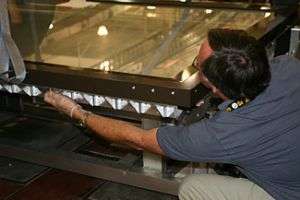
A hermetically sealed glass and aluminum encasement built by the National Institute of Standards and Technology will protect the first world map to label the lands of the New World as “America” when the “Exploring the Early Americas” exhibition opens Dec. 13, 2007, at the Library of Congress (LOC) in Washington, D.C. The 40-square-foot, state-of-the-art display case is the new home for the 1507 Waldseemüller map, often called “America’s birth certificate.”
Protecting America’s historic documents is not a new task for NIST. Twice before (1951 and 2003), the agency built encasements for the nation’s Charters of Freedom—the Declaration of Independence, the Constitution and the Bill of Rights—housed at the National Archives.
However the Waldseemüller map encasement, developed in partnership with the LOC, is six times larger than any of those cases. The new encasement’s frame and base were machined from two solid pieces of aluminum donated by the Alcoa Company. It was sealed with a double sheet of thick, non-reflective laminated glass. The case includes valves for flushing out oxygen (which would chemically react and degrade the map’s paper and ink) and replacing it with inert argon gas. It also includes sensitive monitoring devices to constantly measure internal environmental conditions.
During the manufacturing process, NIST specialists checked the strength of the glass to ensure it would not break during barometric or temperature changes and leak-tested the encasement to certify it would keep oxygen out for at least 20 years. NIST engineers also designed devices for raising and lowering the encasement for maintenance and display.
All of the components were shipped last month to the LOC where they were reassembled prior to the Waldseemüller map’s encasement.
Dianne van der Reyden, LOC director for preservation, accepted the finished device, saying, “When it became time for us to design a case for our new national treasure, NIST was the obvious choice. We have a lot of respect for their engineers and their ingenuity, and we knew that they would be able to get this job done and get it done in time.”
Mark E. Luce, leader of the 11-member NIST encasement team, said, “We at NIST are proud to have had the opportunity to use the skills we use everyday to make world class, unique instruments to preserve ’the birth certificate of America.’”
Source: NIST


