Mars under the spotlight again
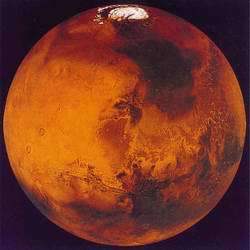
Relieved UK scientists are celebrating the news that NASA’s Mars Reconnaissance Orbiter (MRO) appears to have smoothly entered Mars orbit on Friday night (March 10th). Entering orbit is one of the most critical times for a space mission and Friday night’s manoeuvre managed to boost the tension for all as it took place on the far side of the Red Planet – so no news of the progress could be received on Earth during the critical phase.
UK scientists, from Oxford, Cardiff and Reading Universities are involved in the Mars Climate Sounder (MCS) instrument – essentially a weather station for Mars. It will profile the atmosphere of Mars detecting vertical variation in temperature, dust and water vapour concentration. Two previous versions of this instrument were lost with the ill-fated Mars Observer and Mars Climate Orbiter missions.
Professor Fred Taylor of Oxford University is delighted to have this nail-biting milestone out of the way. He says “Mars approach and orbit insertion is the most risky part of the mission. That is when we lost the last two spacecraft that were carrying our Climate Sounder instrument to Mars, in 1991 and 1999. Successfully achieving orbit this time means that we will be able to start taking some preliminary observations of the Martian atmosphere as early as 20th March.”
He adds “However, MRO will still be in a very elongated orbit then, and will not achieve the circular orbit from which we get the best observations for another six months. Changing the orbit involves the spacecraft dipping into the upper atmosphere of Mars at its closest approach each orbit, using the drag to reduce its speed a little at a time. This 'aerobraking' is also a risky manoeuvre, but not as heart-stopping as arrival at Mars.”
The main aim of the MRO mission is to seek out the history of water on Mars. This will be accomplished by a suite of six science instruments, 3 engineering experiments and 2 science facility experiments. They will zoom in for extreme close up images of the Martian surface, analyse minerals, look for subsurface water, trace how much dust and water are distributed in the atmosphere and monitor the daily global weather.
Source: PPARC


