Wind Turbines Produce 'Green' Energy -- and Airflow Mysteries
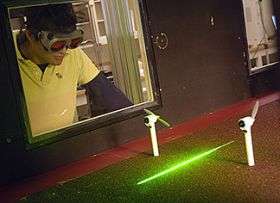
Using smoke, laser light, model airplane propellers and a campus wind tunnel, a team led by Johns Hopkins University researchers is trying to solve the airflow mysteries that surround wind turbines, an increasingly popular source of "green" energy. The National Science Foundation recently awarded the team a three-year, $321,000 grant to support the project.
The rise in oil prices and a growing demand for energy from non-polluting sources has led to a global boom in construction of tall wind turbines that convert the power of moving air into electricity. The technology of these devices has improved dramatically in recent years, making wind energy more attractive.
For example, Denmark is able to produce about 20 percent of its electric energy through wind turbines. But important questions remain: Could large wind farms, whipping up the air with massive whirling blades, alter local weather conditions? Could changing the arrangement of these turbines lead to even more efficient power production? The researchers from Johns Hopkins and Rensselaer Polytechnic Institute hope their work will help answer such questions.
"With diameters spanning up to 100 meters across, these wind turbines are the largest rotating machines ever built," said research team leader Charles Meneveau, a turbulence expert in Johns Hopkins' Whiting School of Engineering. "There's been a lot of research done on wind turbine blade aerodynamics, but few people have looked at the way these machines interact with the turbulent wind conditions around them. By studying the airflow around small, scale-model windmills in the lab, we can develop computer models that tell us more about what's happening in the atmosphere at full-size wind farms."
To collect data for such models, Meneveau's team is conducting experiments in a campus wind tunnel. The tunnel uses a large fan to generate a stream of air moving at about 40 mph. Before it enters the testing area, the air passes through an "active grid," a curtain of perforated plates that rotate randomly and create turbulence so that air currents in the tunnel more closely resemble real-life wind conditions. The air currents then pass through a series of small model airplane propellers mounted atop posts, mimicking an array of full-size wind turbines.
The researchers gather information on the interaction of the air currents and the model turbines by using a high- tech procedure called stereo particle-image-velocimetry. First, they "seed" the air in the tunnel with a form of smoke — tiny particles that move with the prevailing airflow. Above the model turbines, a laser generates two sheet-like pulses of light in quick succession. A camera captures the position of particles at the time of each flash.
"When the images are processed, we see that there are two dots for every particle," said Meneveau, who is the university's Louis M. Sardella Professor of Mechanical Engineering. "Because we know the time difference between the two laser shots, we can calculate the velocity. So we get an instantaneous snapshot of the velocity vector at each point. Having these vector maps allows us to calculate how much kinetic energy is flowing from one place to another, in much greater detail than what was possible before."
Raul B. Cal, a Johns Hopkins postdoctoral fellow who is working on the project with Meneveau, said this data could lead to a better understanding of real wind farm conditions. "What happens when you put these wind turbines too close together or too far apart? What if you align them staggered or in parallel?" he asked. "All of these are different effects that we want to be able to comprehend and quantify, rather than just go out there and build these massive structures, implementing them and not knowing what's going to happen."
Meneveau pointed out that dense clusters of wind turbines also could affect nearby temperatures and humidity levels, and cumulatively, perhaps, alter local weather conditions. Highly accurate computer models will be needed to unravel the various effects involved. "Our research will provide the fluid dynamical data necessary to improve the accuracy of such computer models," Meneveau said. "We'd better know what the effects are in order to implement wind turbine technology in the most sustainable and efficient fashion possible."
Meneveau and Cal are collaborating with Luciano Castillo, associate professor in the Department of Mechanical, Aerospace and Nuclear Engineering at Rensselaer Polytechnic Institute, and Hyung S. Kang, an associate research scientist in the Department of Mechanical Engineering at Johns Hopkins.
Source: Johns Hopkins University


