New Flexible, Transparent Transistors made of Nanotubes
November 27, 2007 By Lisa Zyga feature

New Flexible, Transparent Transistors made of Nanotubes

Enlarge

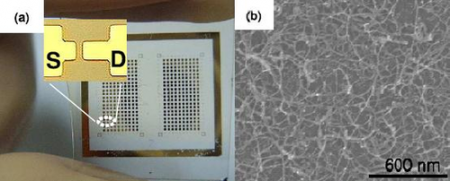
(A) The thin film transistor array on a glass substrate. Inset: A magnified transparent transistor. (B) Scanning electron microscope image of the network of SWNTs. Image credit: Eun Ju Bae, et al.

The ability to create flexible, transparent electronics could lead to a host of novel applications, such as e-paper and electronic car windshields. Now, scientists have constructed a transistor made of a network of nanotubes that may serve as an essential component in a trans-flex device.

Such devices require two main components: light displays and current-controlling transistors. While scientists have found that OLEDs and LCDs work well as light displays, finding a truly transparent and flexible transistor material is still an open area. Usually, these transistors consist of metallic nanowires.

Recently, researchers from Hanyang University in Seoul have constructed a thin film transistor made of networked single-walled carbon nanotubes (SWNTs) on a glass substrate. While it’s not the first thin film transistor made of SWNTs, it has the advantage of allowing a high density of SWNTs to be grown under lower temperatures than normally required.

Most significantly, the method shows that nanotubes can offer a practical choice for fabricating transparent, thin film electronics such as flat-panel displays and future opto-electronics devices.

“This works shows that we are able to build a transistor with thin films of SWNTs, rather than with single SWNTs,” coauthor Wanjun Park told PhysOrg.com. “It means that we have an easier fabrication method for building electronic devices made of nanotubes, without the need to individually control each single tube.”

In a recent issue of Nanotechnology, the researchers explained how the SWNT network can be arranged through a technique called chemical vapor deposition. In this method, the substrate is pre-patterned with catalysts to avoid the need for etching, and the nanotubes can be directly deposited on the substrate. By enhancing this technique with the use of a water plasma, the scientists were able to grow the nanotubes at significantly lower temperatures than in previous methods.

Due to the high SWNT density on the substrate, the nanotubes intersected with each other to form a continuous conductive path. However, for nanotubes above a critical percolation threshold (a measure of connectivity), there was no conductance. In this way, the SWNTs act like semiconductors, providing the basis for the on-off switching in the transistor.

In the future, the scientists plan to make improvements to the nanotube transistors by increasing their mobility and further understanding the complex configuration of the nanotube networks.

“These results are just the beginning,” Park said. “The technology needs lower temperatures for semiconducting SWNT growth, as well as higher transistor performance for real applications. But SWNT is a very robust material with outstanding electrical properties. It can be expected to be one of the candidates for a future electronic material.”

More information: Bae, Eun Ju, Min, Yo-Sep, Kim, Un Jeong, and Park, Wanjun. “Thin film transistors of single-walled carbon nanotubes grown directly on glass substrates.” Nanotechnology 18 (2007) 495203 (4pp).

Copyright 2007 PhysOrg.com.
All rights reserved. This material may not be published, broadcast, rewritten or redistributed in whole or part without the express written permission of PhysOrg.com.

4.5 /5 (77 votes)  

Rank 4.5 /5 (77 votes)
Tags

Relevant PhysicsForums posts

More news stories

Full control of plastic transistors

In an article in the highly ranked interdisciplinary journal PNAS, Loïg Kergoat, a researcher at Linköping University, describes how transistors made of plastic can be controlled with great precision.

Nanotechnology / Nanophysics

created 5 hours ago | popularity 5 / 5 (1) | comments 0

New nanostructure for batteries keeps going and going

(Phys.org) -- For more than a decade, scientists have tried to improve lithium-based batteries by replacing the graphite in one terminal with silicon, which can store 10 times more charge. But after just a ...

Nanotechnology / Nanophysics

created May 11, 2012 | popularity 4.8 / 5 (62) | comments 28 | with audio podcast

Research group creates highly sensitive photodetector from graphene and quantum dots

(Phys.org) -- Researchers in Spain have succeeded in building a photodetector that is a billion times more sensitive than other such detectors based on graphene and could herald the use of graphene based light ...

Nanotechnology / Nanophysics

created May 15, 2012 | popularity 4.4 / 5 (7) | comments 3 | with audio podcast report

Ultrasensitive biosensor promising for medical diagnostics

(Phys.org) -- Researchers have created an ultrasensitive biosensor that could open up new opportunities for early detection of cancer and "personalized medicine" tailored to the specific biochemistry of individual ...

Nanotechnology / Nanophysics

created May 15, 2012 | popularity 5 / 5 (1) | comments 0 | with audio podcast

Researchers generate electricity from viruses

Imagine charging your phone as you walk, thanks to a paper-thin generator embedded in the sole of your shoe. This futuristic scenario is now a little closer to reality. Scientists from the U.S. Department of Energy's Lawrence ...

Nanotechnology / Bio & Medicine

created May 13, 2012 | popularity 5 / 5 (10) | comments 1 | with audio podcast


IPhone to get larger screen: A report to take with a grain of salt?

Apple has begun preparing to launch an iPhone with a larger screen than its previous models, according to a report in the Wall Street Journal.

Healthy eating can cost less, study finds

Is it really more expensive to eat healthy? An Agriculture Department study released Wednesday found that most fruits, vegetables and other healthy foods cost less than foods high in fat, sugar and salt.

"Social Network" writer to pen Steve Jobs film script

Sony Pictures Entertainment on Wednesday said that the Academy Award winning screenwriter behind "The Social Network" will write the script for a film about Apple co-founder Steve Jobs.

NY tech fest heralds Silicon Valley of the East

The Big Apple may not have California's weather, but tech fans at New York Internet Week say that in every other way the city is on course to become Silicon Valley 2.0.

How do consumers achieve self-affirmation when purchasing products?

People who feel good about themselves are less likely to choose an attractive product than a functional one, according to a new study in the Journal of Consumer Research. But choosing highly aesthetic products may make p ...

Why do consumers dislike corporate brands that get too familiar?

Although it is tempting to use the word "we" to make consumers feel like part of the family, people react negatively when brands overstep their boundaries, according to a new study in the Journal of Consumer Research.