Quantum physics 'rules' -- Australian scientists create world's most accurate 'ruler'
Nov 26, 2007
Quantum physics 'rules' -- Australian scientists create world's most accurate 'ruler'
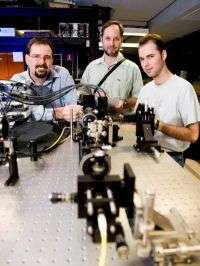
Dr. Geoff Pryde, Professsor Howard Wiseman and PhD candidate Brendon Higgins. Credit: Chris Stacey, Griffith University

NEVER try telling a quantum physicist that near enough is good enough – Australian researchers have invented a technique that, for the first time, measures lengths as accurately as the laws of physics allow.

In a paper published in leading international science journal Nature the research team revealed a system that uses individual photons – single particles of light – as a ruler for microscopic distances. The experiment was performed in the laboratory of Dr Geoff Pryde at Griffith University's Centre for Quantum Dynamics, by him and his PhD student Brendon Higgins. Centre Director, Professor Howard Wiseman, developed the theory, together with University of Sydney's Dr Stephen Bartlett and Macquarie University's Dr Dominic Berry.

Pryde’s apparatus used single photons, with each photon making a number of passes through the sample being measured.

Using just 36 photons making a total of 378 passes, the team was able to measure length differences less than one ten thousandth of the width of a human hair.

“This is an incredibly small amount of light.” said Pryde. “For comparison, scanning a barcode uses quadrillions of photons. Even the dim standby light on your DVD player shines out many trillions of photons a second.”

"Similar schemes based on interferometry – a technique using waves of electromagnetic radiation such as light – have been used for centuries to measure length, and other properties of objects, with great accuracy." said Wiseman.

"The key difference is we have done it in a way that gets as much information out of each pass of a photon through the sample as is allowed by Heisenberg's uncertainty principle. In this sense, it’s the best measurement possible – something that’s never been done before."

"The obvious applications are in making accurate measurements using less light than was previously thought possible. This is particularly important in fields such as medical research, as passing light through a biological sample can damage it," said Pryde.

So why do we need to measure with such accuracy?

"Measurement underpins all science, and through history we've seen that advances in precision measurement lead to unexpected scientific discoveries, which in turn lead to new technologies and applications," Pryde said.

"Old-style interferometers taught us that the Earth wasn’t moving through a mysterious substance called 'aether', but actually through a vacuum. This ultimately led to Einstein’s theory of relativity. We don’t know yet where this new technique will lead us.”

The team's next goal is to use more single photons and passes to get an even finer measurement.

"In principle this is possible, but there are some technological hurdles to overcome first!” said Pryde.

In the strange world of quantum physics, a photon can simultaneously take two different paths to the same destination. Where the photon goes next depends on the difference between the lengths of the two paths. If the length of one path is known, this allows scientists to measure the length of the other path with great accuracy. The novel feature of the Griffith experiment is to make the photon retrace the paths many times before detecting it. This amplifies the effect of the difference in path lengths. The same idea can also be applied to measuring other quantities like speed, frequency, and time.

The technique combined concepts from research in quantum computers (through Australia’s Centre for Quantum Computer Technology), in quantum control, and in quantum communication. “This is a great example of ideas coming together from different directions to make something new and exciting,” said Bartlett.

Source: Research Australia

Explore further: Breakthrough calls time on bootleg booze

add to favorites email to friend print save as pdf

Related Stories

Quantum dot LED approaches theoretical maximum efficiency

May 14, 2013

(Phys.org) —Quantum dot LEDs (QLEDs) are a promising technology for creating large-area displays that could have applications for TVs, cell phones, and digital cameras. So far, however, the highest efficiencies ...

New principle may help explain why nature is quantum

May 14, 2013

Like small children, scientists are always asking the question 'why?'. One question they've yet to answer is why nature picked quantum physics, in all its weird glory, as a sensible way to behave. Researchers ...

Photonic quantum computers: A brighter future than ever

May 13, 2013

(Phys.org) —Harnessing the unique features of the quantum world promises a dramatic speed-up in information processing as compared to the fastest classical machines. Scientists from the Group of Philip ...

Manipulating Lorentz and Fano spectral line shapes

May 13, 2013

(Phys.org) —It is widely known that the optical properties of certain materials can be modified by using lasers to control the quantum states of their optical electrons. Lasers that can generate ultra-short ...

Recommended for you

Breakthrough calls time on bootleg booze

7 hours ago

(Phys.org) —Using a laser, the St Andrews scientists can now carry out detailed analysis of a spirit sample no bigger than a teardrop and can even confirm whether it is toxic or not. It's hoped the testing ...

Bringing life into focus

May 17, 2013

Spinning-disk confocal microscopy is an optical imaging technique that can be used to generate detailed three-dimensional fluorescence images of living cells and their contents. Although a powerful tool for ...

World's smallest droplet

May 17, 2013

(Phys.org) —Physicists may have created the smallest drops of liquid ever made in the lab. That possibility has been raised by the results of a recent experiment conducted by Vanderbilt physicist Julia Velkovska and her ...

User comments : 1

Adjust slider to filter visible comments by rank

Display comments: newest first

Sparkygravity
not rated yet Dec 22, 2007
I wonder if this could help Ligo?

More news stories

Lab sets a new record for creating heralded photons

(Phys.org) —Entanglement, by general consensus of physicists, is the weirdest part of quantum science. To say that two particles, A and B, are entangled means that they are actually two parts of an inseparable ...

Breakthrough calls time on bootleg booze

(Phys.org) —Using a laser, the St Andrews scientists can now carry out detailed analysis of a spirit sample no bigger than a teardrop and can even confirm whether it is toxic or not. It's hoped the testing ...

Competition in the quantum world

Innsbruck physicists led by Rainer Blatt and Peter Zoller experimentally gained a deep insight into the nature of quantum mechanical phase transitions. They are the first scientists that simulated the competition ...

New principle may help explain why nature is quantum

Like small children, scientists are always asking the question 'why?'. One question they've yet to answer is why nature picked quantum physics, in all its weird glory, as a sensible way to behave. Researchers ...

Study shows how bilinguals switch between languages

(Medical Xpress)—Individuals who learn two languages at an early age seem to switch back and forth between separate "sound systems" for each language, according to new research conducted at the University of Arizona.

Non-wetting fabric drains sweat

(Phys.org) —Waterproof fabrics that whisk away sweat could be the latest application of microfluidic technology developed by bioengineers at the University of California, Davis.