Ausonia Mensa remnant massif
Mar 02, 2006
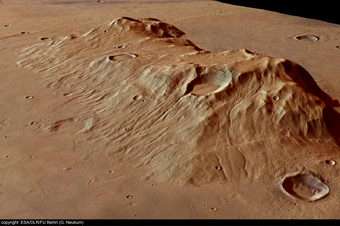
Perspective view of the Ausonia Mensa massif

These images, taken by the High Resolution Stereo Camera (HRSC) on board ESA's Mars Express spacecraft, show the Ausonia Mensa massif on Mars.

The HRSC obtained these images during orbit 506 with a ground resolution of approximately 37.6 metres per pixel. The scenes show the region of Hesperia Planum, containing the massif, at approximately 30.3° South and 97.8° East. North is to the right in these images. Ausonia Mensa is a large remnant mountain with several impact craters, rising above basaltic sheet layers. The mountain stretches over an area of about 98 kilometres by 48 kilometres and has an elevation of 3700 metres.

A large crater, approximately 7.5 kilometres in diameter and 870 metres deep, has been partially filled with sediment. The northern flank of the crater is broken by a large gully caused by erosion.

Numerous branched channels, also resulting from erosion, run along the edge of top of the plateau toward the plains at the foot of the mountain.

The western flank of the mountain is dominated by a large crater, about six kilometres in diameter, which clearly shows an ejecta blanket and secondary cratering.

Aeolian, or 'wind-created', structures are visible about 50 kilometres to south-east of the massif, indicating channeling of atmospheric flow. They are clearly visible because of their different colour.

A heavily eroded, partially filled crater of approximately six kilometres diameter is visible to the north of the massif. The crater is characterised by numerous, smaller and younger craters.

The colour scenes have been derived from the three HRSC-colour channels and the nadir channel.

The perspective views have been calculated from the digital terrain model derived from the stereo channels.

The 3D anaglyph image was calculated from the nadir and one stereo channel. Image resolution has been decreased for use on the internet.

Source: European Space Agency

Explore further: Bold action, big money needed to curb Asia floods

add to favorites email to friend print save as pdf

Related Stories

Did a Pacific Ocean meteor trigger the Ice Age?

Sep 19, 2012

(Phys.org)—When a huge meteor collided with Earth about 2.5 million years ago in the southern Pacific Ocean it not only likely generated a massive tsunami but also may have plunged the world into the Ice ...

Cuneiform clay tablet translated for the first time

Mar 31, 2008

A cuneiform clay tablet that has puzzled scholars for over 150 years has been translated for the first time. The tablet is now known to be a contemporary Sumerian observation of an asteroid impact at Köfels, ...

Recommended for you

Bold action, big money needed to curb Asia floods

9 hours ago

Asia's flood-prone megacities should fund major drainage, water recycling and waste reduction projects to stem deluges and secure clean supply for their booming populations, experts said Sunday.

Heat-related deaths in Manhattan projected to rise

10 hours ago

Residents of Manhattan will not just sweat harder from rising temperatures in the future, says a new study; many may die. Researchers say deaths linked to warming climate may rise some 20 percent by the 2020s, ...

Dire outlook despite global warming 'pause': study

10 hours ago

A global warming "pause" over the past decade may invalidate the harshest climate change predictions for the next 50 to 100 years, a study said Sunday—though levels remain in the danger zone.

China 'will not accept' carbon tax on EU flights: report

13 hours ago

China will not pay for CO2 emissions by its airlines on flights within Europe, a top civil aviation official reportedly said after the European Commission warned eight Chinese firms face fines for nonpayment.

Mice, gerbils perish in Russia space flight

14 hours ago

A number of mice and eight gerbils sent into space in a Russian capsule destined to find out how well organisms can withstand extended flights perished during their journey, scientists said Sunday as the ...

User comments : 0

More news stories

Heat-related deaths in Manhattan projected to rise

Residents of Manhattan will not just sweat harder from rising temperatures in the future, says a new study; many may die. Researchers say deaths linked to warming climate may rise some 20 percent by the 2020s, ...

Mice, gerbils perish in Russia space flight

A number of mice and eight gerbils sent into space in a Russian capsule destined to find out how well organisms can withstand extended flights perished during their journey, scientists said Sunday as the ...

Kinks and curves at the nanoscale

One of the basic principles of nanotechnology is that when you make things extremely small—one nanometer is about five atoms wide, 100,000 times smaller than the diameter of a human hair—they are going ...

Honeybees trained in Croatia to find land mines

(AP)—Mirjana Filipovic is still haunted by the land mine blast that killed her boyfriend and blew off her left leg while on a fishing trip nearly a decade ago. It happened in a field that was supposedly ...