Persistence pays off
Oct 26, 2007
Persistence pays off
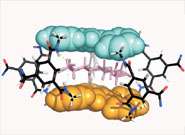
A computational ´synthetic lectin´, with a cellobiose molecule (pink) held inside. Photo by Professor Tony Davis

Chemists have come remarkably close to mimicking a type of protein previously thought impossible to imitate. The long-term application of this work could be in the development of new types of glucose sensors for diabetics, or in the production of new biofuels.

Professor Anthony Davis and his team at the University of Bristol, UK, report this week in Science that they have designed a totally synthetic molecule which mimics the properties of lectins. The molecule binds a particular kind of carbohydrate (cellobiose), while ignoring almost all other carbohydrates. This has previously proved extremely difficult to do.

Lectins are proteins which bind to carbohydrates such as glucose. They are found throughout nature, particularly in plants. By designing synthetic molecules with appropriate shapes, chemists should, in theory, be able to mimic the properties of such biomolecules and then adjust them to suit the needs of humanity. Unfortunately this has proved extremely difficult in practice.

Lectins are large, complex proteins which have evolved to do their jobs over billions of years and it is generally assumed that we cannot realistically hope to match them with artificial systems. Indeed, efforts to do so have usually been disappointing. But research at Bristol University suggests that perhaps we shouldn't give up so easily.

Professor Davis said: “This work should help scientists understand lectins themselves and may lead to specific applications in the future. For example, cellobiose is closely related to cellulose, a key renewable resource which can be used to make materials, biofuels and other chemicals.

“Cellulose is difficult to exploit because of its insolubility, but if it could be bound and made soluble by a synthetic lectin, new ways of processing it should be possible. The researchers are also aiming for molecules which bind selectively to glucose. These could be used in new types of glucose sensor, for use in the treatment of diabetics.”

Source: University of Bristol

Explore further: Long distance calls by sugar molecules

add to favorites email to friend print save as pdf

Related Stories

Making sense of misfolded proteins

Oct 03, 2012

The endoplasmic reticulum of cells provides a pivotal quality-control system that eliminates improperly folded, or misfolded, glycoproteins, such as antibodies and hormones. The UDP-glucose:glycoprotein glycotransferase ...

Creating energy from light and air

May 08, 2012

Researchers from the University are studying how to make electricity from electrodes coated in bacteria, and other living cells, using light or hydrogen as the fuel.

Lactate shuttle may fuel the injured brain

Nov 24, 2010

The same fundamental biological mechanism that helps athletes develop endurance on a treadmill may someday be tapped into by doctors in intensive care units to save and improve the lives of patients with traumatic ...

Recommended for you

Long distance calls by sugar molecules

11 hours ago

All our cells wear a coat of sugar molecules, so-called glycans. ETH Zurich and Empa researchers have now discovered that glycans rearrange water molecules over long distances. This may have an effect on ...

Counting small RNA in disease-causing organisms

17 hours ago

Small molecules of RNA (tens to hundreds of nucleotides in length) play a key regulatory role in bacteria. Due to their small size, directly measuring the number of small RNA (sRNA) present in a single bacterium ...

User comments : 0

More news stories

Long distance calls by sugar molecules

All our cells wear a coat of sugar molecules, so-called glycans. ETH Zurich and Empa researchers have now discovered that glycans rearrange water molecules over long distances. This may have an effect on ...

Counting small RNA in disease-causing organisms

Small molecules of RNA (tens to hundreds of nucleotides in length) play a key regulatory role in bacteria. Due to their small size, directly measuring the number of small RNA (sRNA) present in a single bacterium ...

3D printing tiny batteries

(Phys.org) —3D printing can now be used to print lithium-ion microbatteries the size of a grain of sand. The printed microbatteries could supply electricity to tiny devices in fields from medicine to communications, ...