Droplets that Roll Uphill
Sep 24, 2007
Climbing Droplets
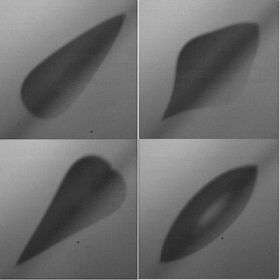
Droplets of a glycerol-water mixture defy gravity to climb up hill, provided the surface under them is shaken in the right way. The discovery may lead to new methods to manipulate microscopic amounts of fluids. Credit: P. Brunet, J. Eggers, and R.D. Deegan

A recent experiment conducted by physicists at University of Bristol in the United Kingdom has shown that liquid drops can defy gravity. Droplets of liquid on an inclined plate that is shaken up and down can travel uphill rather than sliding down. In fact, if the plate vibrates at the right rate, the droplets will always travel counter-intuitively up the incline.

The reason has to do with pushing and pulling. As the plate rises, it pushes the droplet upward, and as it falls, it pulls the droplet down. Inertia would have the droplet slide down as the plate moved upward. Similarly, the droplet would climb up the incline as the plate drops, resisting the rapid downward acceleration.

However, the forces that hold the droplet to the plate are stronger as the plate rises. During the time that the droplet would be moving downhill, it is stuck more firmly to the plate. Therefore, the droplet gains more ground moving up the incline as the plate falls than it loses as the plate rises. Overall, the droplets travel uphill.

If the vibration doesn't apply enough force to the droplet, it will just sit still on the inclined plate. As the force increases, the droplet will begin to slide. Increasing the forces further, the droplet sits still again. Turn up the force on the droplet a little more, and it starts to climb.

Since the droplet must withstand a fair amount of force, alternately pushing and pulling, the fluid has to be somewhat thick or viscous. Pure water droplets will break apart before the forces are strong enough to cause them to climb. On the other end, the drops move very slowly if the fluid is too thick. Nevertheless, this method for moving droplets using vibrations may prove useful in the manipulation of microscopic fluids.

Citation: P. Brunet, J. Eggers, and R.D. Deegan, Physical Review Letters, forthcoming article

Source: American Physical Society

Explore further: Kenneth Wilson, Nobel winner for physics, dies

add to favorites email to friend print save as pdf

Related Stories

Jumping droplets help heat transfer

Jan 03, 2013

Many industrial plants depend on water vapor condensing on metal plates: In power plants, the resulting water is then returned to a boiler to be vaporized again; in desalination plants, it yields a supply of clean water. ...

Integrated optical vortices on a chip (w/ Video)

Oct 18, 2012

An international research group led by scientists from the University of Bristol and the Universities of Glasgow (UK) and Sun Yat-sen and Fudan in China, have demonstrated integrated arrays of emitters of ...

Curiosity in it for the long haul

Aug 28, 2012

In recent days, Curiosity has accomplished a number of firsts, including the first use of its laser to zap a nearby rock and its first short drive. Many more such firsts lie ahead. But as the rover prepares ...

How geckos cope with wet feet

Aug 09, 2012

Geckos are remarkable little creatures, clinging to almost any dry surface, and Alyssa Stark, from the University of Akron, USA, explains that they appear to be equally happy scampering through tropical rainforest ...

Recommended for you

EUROnu project recommends building Neutrino Factory

3 hours ago

(Phys.org) —The European Union's Seventh Framework Programme, EUROnu, has submitted its findings to a panel at CERN. Charged with choosing a project to study the nature of matter and antimatter, the project ...

RHIC's perfect liquid a study in perfection

Jun 18, 2013

(Phys.org) —When heavy ions (the nuclei of heavy atoms such as gold and lead) collide at high energies at Brookhaven National Laboratory's Relativistic Heavy Ion Collider (RHIC) and Europe's Large Hadron Coll ...

User comments : 0

More news stories

EUROnu project recommends building Neutrino Factory

(Phys.org) —The European Union's Seventh Framework Programme, EUROnu, has submitted its findings to a panel at CERN. Charged with choosing a project to study the nature of matter and antimatter, the project ...