A Giant Trilobite on the Sun
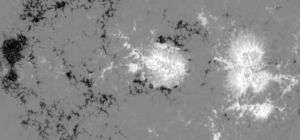
"We've never seen anything quite like it," says solar physicist Lika Guhathakurta from NASA headquarters.
Last week she sat in an audience of nearly two hundred colleagues at the "Living with a Star" workshop in Boulder, Colorado, and watched in amazement as Saku Tsuneta of Japan played a movie of sunspot 10926 breaking through the turbulent surface of the sun. Before their very eyes an object as big as a planet materialized, and no one was prepared for the form it took.
"It looks like a prehistoric trilobite," said Marc De Rosa, a scientist from Lockheed Martin's Solar and Astrophysics Laboratory in Palo Alto, Calif. "To me it seemed more like cellular mitosis in which duplicated chromosomes self-assemble into two daughter cells," countered Guhathakurta.
Click here and decide for yourself. (From beginning to end, the movie spans 6 days. The "trilobite" centered above is about the size of Earth.)
"This movie is a magnetogram—a dynamic map tracing the sunspot's intense magnetism," Guhathakurta explains. "Black represents negative (S) polarity, and white represents positive (N)."
The data were gathered by the Japanese Space Agency's Hinode spacecraft, launched in Sept. 2006 on a mission to study sunspots and solar storms. "This is the highest resolution magnetogram ever taken from space," says Tsuneta, Hinode's chief scientist at the National Astronomical Observatory of Japan in Tokyo. "It's showing us things we've never seen before."
Magnetograms are the best way to study sunspots. Why? Although sunspots may appear solid and sturdy, they are not made of matter. Sunspots are planet-sized knots of magnetism created by the sun's inner dynamo. Born in the depths, they bob to the solar surface where they can shift, merge, split and even appear to "swim."
"Sometimes the shifting and merging gets out of hand," says Guhathakurta. "Magnetic fields become unstable and explode, producing a powerful solar flare." The effects are manifold: flares can disrupt communications on Earth, disable satellites, threaten astronauts with deadly radiation storms and (on the bright side) trigger lovely aurora borealis--the Northern Lights. Although researchers have been studying flares for more than a century, they still cannot issue accurate flare forecasts--something astronauts in orbit or en route to the Moon would dearly love to have. Improving this situation is a key goal of the Hinode mission.
Participants at the Living With A Star workshop were amazed by the quality of Hinode's data. "The sensitivity of Hinode's Solar Optical Telescope is much higher than anything we've ever launched before. This allows Hinode to detect even the very faintest magnetic fields." By watching the ebb and flow of magnetism and the surprising forms that emerge, "we hope to understand the behavior of sunspots and predict their eruptions."
But first they've got to deal with the trilobites. "We have a lot of work to do," says Guhathakurta. "But what a wonderful problem."
Source: Science@NASA, by Dr. Tony Phillips


