Carbon Nanotubes Store Hydrogen in Step Toward Hydrogen Vehicles
Imagine this: your fuel gauge is hovering near empty. You stop by the nearest store, turn in your empty hydrogen cartridge, buy a full one and pop it into your car. Presto, you’re on your hydrogen-powered way again, emitting just the faintest traces of water out the tailpipe.
Researchers at SSRL and Stanford have taken a step closer to this futuristic vision by adding hydrogen to tiny cylinders made entirely out of carbon. Carbon nanotubes, 50,000 times narrower than a human hair, have excited the imaginations of scientists hoping to make nano-electronics. Recent experiments at SSRL and the Advanced Light Source in Berkeley have shown that the tubes are also a promising material for storing hydrogen safely, efficiently and compactly.
The basic idea is this: use electricity to split water into hydrogen (and oxygen) atoms, put the hydrogen into a fuel cell, which strips the electron from the hydrogen atom and forces it across a membrane, generating an electrical current which can power your car. The hydrogen ions are reunited with oxygen, making a watery exhaust.
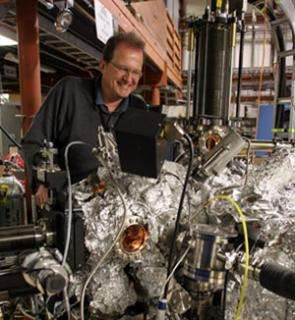
In their attempt to store hydrogen, the researchers bombarded a film of carbon nanotubes with a hydrogen beam. Then they studied the film with different x-ray spectroscopy techniques to see if any hydrogen atoms had formed chemical bonds with the carbon. To their delight, they found that about 65 percent of the carbon atoms had bonded to hydrogen atoms.
“It was a surprise that we could get so many carbon-hydrogen bonds. It gives us hope it can be used as a material for storing hydrogen,” said Anders Nilsson (Materials Research).
Single-walled carbon nanotubes are essentially a one-atom-thick layer of carbon rolled into a tube. All the carbon atoms are on the surface, allowing easy access for bonding. The carbon atoms have double bonds with each other. The incoming hydrogens break the double bonds, allowing a hydrogen to attach to a carbon while the carbon atoms renew their grip on each other with single bonds. The carbon nanotubes offer safe storage because the hydrogen atoms are bonded to other atoms, rather than freely floating as a potentially explosive gas.
The researchers estimated that five percent of the total weight of the hydrogenated nanotubes came from the hydrogen atoms, and they are already working to boost that number. For its FreedomCAR program, the Department of Energy has set the goal of developing a material that can hold six percent of the total weight in hydrogen by the year 2010. Because hydrogen is the lightest element, the storage material also needs to be light—as is carbon—to hold a high percentage of hydrogen by weight.
In addition to upping the weight percent of hydrogen, researchers also need to overcome challenges in releasing the stored hydrogen so it can be used in a fuel cell. Currently the hydrogen-carbon bonds break above 600 °C, but two cycles of hydrogenating the carbon nanotubes and then breaking the hydrogen-carbon bonds appears to cause defects in the tubes. Ideally, the hydrogen would be released at 50 to 100 °C. Adding metal catalysts and adjusting the radius of the tubes are potential solutions.
This was the first experiment conducted on the new SPEAR3 beamline 5-1. The work was supported by the Global Climate Energy Project as well as the DOE.
Source: Stanford Linear Accelerator Center, by Heather Rock Woods


