Higher social skills are distinctly human, toddler and ape study reveals
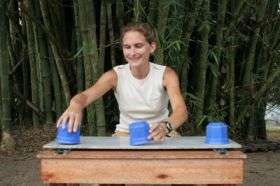
Apes bite and try to break a tube to retrieve the food inside while children follow the experimenter's example to get inside the tube to retrieve the prize, showing that even before preschool, toddlers are more sophisticated in their social learning skills than their closest primate relatives, according to a report published in the 7 September issue of the journal Science.
This innate proficiency allows them to excel in both physical and social skills as they begin school and progress through life.
"We compared three species to determine which abilities and skills are distinctly human," explained Esther Herrmann of the Max Planck Institute for Evolutionary Anthropology in Leipzig, Germany and lead author of the research paper. Humans differ from their great ape relatives because human brains are about three times the size of the closest primate relatives and humans have language, symbolic math and scientific reasoning.
"Social cognition skills are critical for learning," Herrmann said. The children were much better than the apes in understanding nonverbal communications, imitating another's solution to a problem and understanding the intentions of others," she said.
This is the first comprehensive test comparing social and physical skills of children, chimpanzees and orangutans, Herrmann explained, adding that the findings provide important insight into the evolution of human cognition.
The findings support the cultural intelligence hypothesis that suggests that humans have distinctive social cognitive skills to interact in cultural groups, Herrmann said. An alternate hypothesis suggests that humans differ from apes uniformly across physical and social cognitive tasks because they have more general intelligence.
About 230 subjects – chimps, orangutans and 2.5 year-old children – were compared using a battery of tests and found all to be about equal in the physical cognitive skills of space, quantities and causality. In the social skills of communication, social learning and theory-of-mind skills, the children were correct in about 74 percent of the trials, while the two ape species were correct only about 33 percent of the time.
The researchers chose to study children at an age when they have about the same physical skill level of chimpanzees. Children at 2.5 years are old enough to handle these tasks and people have not taught them too much so they provide a good comparison, Herrmann said. The apes ranged in age from 3 to 21.
All of the subjects – about 100 chimps (Pan troglodytes), 100 children (Homo sapiens) and 30 of the more evolutionarily distant orangutans (Pongo pygmaeus) – were given the same cognitive tests that the Max Planck group developed and named the Primate Cognition Test Battery. The battery analyzes primate cognition dealing with the physical and social world (involved in foraging, for example) and was developed based on the primate cognition research of coauthors Josep Call of the Max Planck Institute for Evolutionary Anthropology and Michael Tomasello of the Max Planck Institute for Evolutionary Anthropology.
In one example of the social learning tasks, a researcher demonstrated how to pop open a plastic tube to retrieve food or a toy inside. The children watched and copied. The chimps and orangutans did not imitate the researcher and instead tried to break the tube or pull the contents out with their teeth.
The tests took between three and five hours and were spread between five and eight days over two weeks. The apes were tested in the sanctuaries where they live in Africa and Indonesia.
Source: American Association for the Advancement of Science


