Accumulator ring commissioning latest step for spallation neutron source
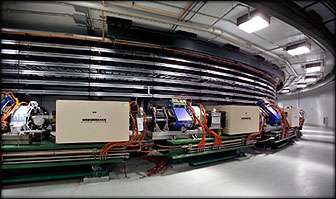
The Department of Energy's Spallation Neutron Source, located at Oak Ridge National Laboratory, has passed another milestone on the way to completion this year--the commissioning of the proton accumulator ring. The accumulator ring is the final step in a proton's journey through the accelerator before it strikes the SNS's mercury target, "spalling" away neutrons to be used for research.
The DOE Office of Science facility will produce the world's most intense neutron beams to probe the molecular structures of materials. As a user facility, the SNS is expected to attract researchers from all over the globe.
"The ring is the last major accelerator element delivered by one of the partner labs in the six-laboratory project," said SNS Director Thom Mason. "Its successful operation confirms not just the robustness of the Brookhaven National Laboratory components but also the full integration of accelerator hardware designed and built using expertise throughout the national DOE complex. We are looking forward to the first beam on target later this year."
Brookhaven Lab led the design and construction of the accumulator ring, which will allow an order of magnitude more beam power than any other facility in the world.
In SNS operation, the superconducting linac produces proton pulses traveling at almost 90 percent of the speed of light. In the ring, the protons within a pulse are "accumulated" to increase the intensity 1,000-fold. At that point, this now very intense pulse is extracted and delivered to the mercury target to produce neutrons. This happens 60 times per second.
After only three days of its initial operation, the ring accumulated protons, which were then extracted and sent to a point just short of the target.
"With this extraordinary success, we are definitely on our way to operate the world's highest intensity proton accelerator," said SNS Accelerator Systems Division Director Norbert Holtkamp.
"The successful commissioning of the accumulator ring--in record time for this type of device--is a testament to the extraordinary collaboration between Brookhaven and Oak Ridge," said Jie Wei, who led the Brookhaven team.
Because of their lack of charge, neutrons have a superior ability to penetrate materials. Researchers can determine a material's molecular structure by analyzing the way the neutrons scatter after striking atoms within a target material. SNS will direct the spalled neutrons to a host of state-of-the-art instruments.
The SNS will become the world's leading research facility for study of the structure and dynamics of materials using neutrons. It will operate as a user facility that will enable researchers from the United States and abroad to study the science of materials that forms the basis for new technologies in telecommunications, manufacturing, transportation, information technology, biotechnology and health.
SNS will increase the number of neutrons available to researchers nearly tenfold, providing clearer images of molecular structures. Together, ORNL's High Flux Isotope Reactor and SNS will represent the world's foremost facilities for neutron scattering, a technique pioneered at ORNL shortly after World War II.
Five Department of Energy Office of Science laboratories--Argonne, Berkeley, Brookhaven, Jefferson and Los Alamos--participated with Oak Ridge in the design of the SNS project. The $1.4 billion project has been constructed on time and on budget with a safety record of 4.2 million hours without a lost workday injury.
Source: Oak Ridge National Laboratory


