Novel 3-D cell culture model shows selective tumor uptake of nanoparticles
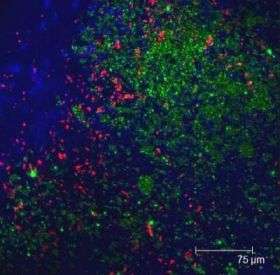
A nanoparticle drug delivery system designed for brain tumor therapy has shown promising tumor cell selectivity in a novel cell culture model devised by University of Nottingham scientists. The project, conducted jointly in the Schools of Pharmacy, Biomedical Sciences and Human Development, will be featured in the September issue of the Experimental Biology and Medicine.
Therapy for brain cancers is particularly difficult for a number of reasons, including getting sufficient drug to the tumor and selectivity of drug action. “We are working on a number of new therapeutic approaches using nanoparticle drug delivery systems explained Dr Martin Garnett, Associate Professor of drug delivery at the School of Pharmacy, however, understanding and developing these systems requires suitable models for their evaluation.”
The nanoparticles used in this study were prepared from a novel biodegradable polymer poly(glycerol adipate). The polymer has been further modified to enhance incorporation of drugs and make the nanoparticles more effective.
“The interaction of tumor cells with brain cells varies between different tumors and different locations within the brain explained Dr Terence Parker, Associate Professor in the School of Biomedical Sciences. Using 3-dimensional culture models is therefore important in ensuring that the behavior of cells in culture is similar to that seen in real life.”
The work was mainly carried out by graduate student Weina Meng who formulated the fluorescently labeled nanoparticles and studied them in a variety of tumor and brain cell cultures. Her early studies showed faster uptake of nanoparticles into tumor cell cultures than normal brain cell cultures grown separately. This selectivity was only seen in 3-dimensional cultures and was the driving force to develop a more complex and representative model.
Tumor cell aggregates have been used as cell culture models of cancer cells for many years. Similarly thin brain slices from newborn rats can be cultured for weeks and are an important tool in brain biology. In the cell co-culture model now reported, these two techniques have been brought together for the first time. Brain tumor cell aggregates were labeled with fluorescent iron microparticles and grown on normal newborn rat-brain tissue slices. The double cell labeling technique allowed investigation of tumor cell invasion into brain tissue by either fluorescence or electron microscopy from the same samples. Using these techniques the tumor aggregates were found to invade the brain slices in a similar manner to tumors in the body. Having developed the model then the tumor selective uptake of nanoparticles was demonstrated in the co-culture.
The collaboration on this project has been nurtured by Professor David Walker of the School of Human Development who co-founded the Children’s Brain Tumor Research Group at Nottingham. “Understanding the biology of tumors is important if we are to develop effective new treatments said Professor Walker. This work demonstrates how close co-operation between disciplines can help to push forward ideas which could lead to new clinical therapies.”
Dr. Steven R. Goodman, Editor-in-Chief of Experimental Biology and Medicine, agrees with Professor Walker. Dr. Goodman stated “The convergence of cancer cell biology and nanoscience, exemplified by this study, holds great promise for the future of brain tumor therapy.” Experimental Biology and Medicine is a journal dedicated to the publication of multidisciplinary and interdisciplinary research in the biomedical sciences.
Source: Society for Experimental Biology and Medicine


