Chathams research challenges theory on New Zealand prehistory
Aug 16, 2007
Chathams research challenges theory on New Zealand prehistory

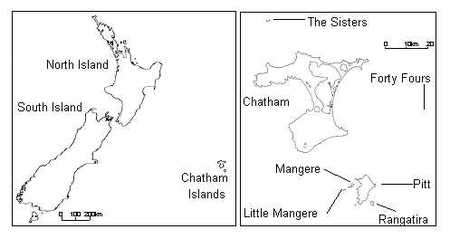
A combination of geological and biological findings are lending weight to the possibility that the Chatham Islands were under water until three million years ago, and that New Zealand’s flora and fauna may have evolved in another large island near New Zealand.

Traditional thinking is that the islands of New Zealand split from the ancient super-continent Gondwanaland about 85 million years ago, and stayed above the oceans since then.

This is challenged by the findings of the multidisciplinary project that has been researching the Chathams, named the Chatham Islands Emergent Ark Survey. The team of biologists and geologists includes Dr Steve Trewick, Senior Lecturer at the Allan Wilson Centre for Molecular Ecology and Evolution. Dr Trewick was part of a team who visited the islands in 2004.

Findings include identification of remnants of deepwater limestone from about three million years ago, overlaid by beach deposits of sand, indicating that the Chathams may be much younger than previously thought. A further significant discovery was the previously unmapped formation in the southwest corner of the Chathams, volcanic rocks of a type that erupted and accumulated on the seashore. By using fossils from within the rocks and radiometric ageing, researchers found the formation was deposited between 2.5 million and 4.5 million years ago. The rocks were originally on the seabed, but now form the highest point on the Chathams, indicating that the entire land area was under the sea until uplift about two million years ago raised it to above the water level.

Biological findings now coming to hand are compatible with the geological findings, indicating that Chatham Islands birds and plants have been separated from their New Zealand relatives for up to three million years.

The final report on the Marsden-funded project is due next year. Participants include staff from Otago, Lincoln and Massey universities and GNS Science.

Source: Massey University

Explore further: Professor argues Earth's mantle affects long-term sea-level rise estimates

add to favorites email to friend print save as pdf

Related Stories

Ancient Antarctic treasure trove discovered

Dec 27, 2012

(Phys.org)—The chance discovery of a 100 million year old fossil forest on an island east of New Zealand has unlocked new insights on ancient life close to the South Pole.

Earth Hour aims for hope in darkened world

Mar 25, 2011

Lights will go out around the world Saturday with hundreds of millions of people set to take part in the Earth Hour climate change campaign, which this year will also mark Japan's earthquake and tsunami.

Landmarks, cities worldwide unplug for Earth Hour

Mar 27, 2010

(AP) -- Europe's best known landmarks - including the Eiffel Tower, Big Ben and Rome's Colosseum - fell dark Saturday, following Sydney's Opera House and Beijing's Forbidden City in joining a global climate ...

Group says 3 more birds close to extinction

May 14, 2009

(AP) -- An Ethiopian lark, a Galapagos finch and a spectacularly colored hummingbird only recently discovered in Colombia have been added to the list of the world's most threatened species, an environmental group said Thursday. ...

Recommended for you

Strong earthquake at exceptional depth

12 hours ago

This morning at 05:45 CEST, the earth trembled beneath the Okhotsk Sea in the Pacific Northwest. The quake, with a magnitude of 8.2, took place at an exceptional depth of 605 kilometers. Because of the great ...

Marine forecasting on the horizon for Indian Ocean Rim

12 hours ago

Nearly all of the member countries of the Indian Ocean Rim Association for Regional Cooperation (IOR-ARC) will attend the week-long workshop to further cooperation and understanding on international ocean ...

Russia evacuates drifting Arctic research station

May 23, 2013

Russia has ordered the urgent evacuation of the 16-strong crew of a drifting Arctic research station after ice floe that hosts the floating laboratory began to disintegrate, officials said Thursday.

User comments : 0

More news stories

Galaxies fed by funnels of fuel

(Phys.org) —Computer simulations of galaxies growing over billions of years have revealed a likely scenario for how they feed: a cosmic version of swirly straws.

Dark, massive asteroid to fly by Earth on May 31

It's 1.7 miles long. Its surface is covered in a sticky black substance similar to the gunk at the bottom of a barbecue. If it impacted Earth it would probably result in global extinction. Good thing it is ...

Source of life running out: water scientists

The majority of people on Earth people will face severe water shortages within a generation or two if pollution and waste continues unabated, scientists warned at a conference in Bonn Friday.

Google eyes emerging markets networks

Google has become deeply involved in a series of projects to build and operate wireless networks in emerging markets including sub-Saharan Africa and Southeast Asia, a report said Friday.