Illuminating a Second 'Kink' in High-Tc Superconductors
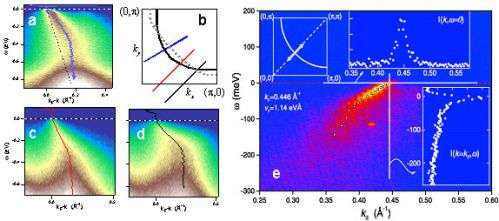
There’s another kink in the mystery of high-temperature (Tc) superconductors – literally. Using photoemission studies at the NSLS, a group of researchers has revealed a new anomaly, or “kink,” in the energy spectrum of high-energy electrons in two different families of cuprate superconductors, further complicating their quest to discover exactly how the materials conduct electricity with zero resistance.
In 1999, a group of researchers led by BNL physicist Tonica Valla discovered a low-energy kink in the energy bands of electrons in high-Tc superconductors just as they went through the transition temperature from their normal to superconducting state. This spectral abnormality is thought to be signature of an interaction or “coupling” between an electron and an excitation such as a phonon, which is a vibration of the ions that form the lattice of a superconductor’s crystal.
“In conventional low-temperature superconductors, this is really the interaction that causes superconductivity,” Valla said. “And there was a hope that when we saw a similar kink in high-temperature superconductors that maybe the mechanism of superconductivity would be resolved. But it’s not that easy.”
While some groups hold that the mechanism is the same as in conventional superconductors — that is, that phonons are responsible for electron pairing – other scientists believe that changes in the spin alignment, or magnetic polarity (magnons), of adjacent electrons are responsible. However, because both excitations are found in the energy range of the low-energy kink – between 40 and 70 meV – it’s difficult to determine which mechanism is correct.
And recently, Valla’s group has thrown another complication into the mix, unveiling a second and much larger kink in the high-Tc superconductors “LBCO” (named for the elements it contains: lanthanum, barium, copper, and oxygen) and “BSCCO” (containing bismuth, strontium, calcium, copper, and oxygen). Using high-resolution spectrometers at NSLS beamline U13UB, Valla’s group measured the energy and the angle at which the electrons were emitted from the superconducting crystals, allowing them to reconstruct the original electrons’ state. This time around, the research team found a large anomaly in the energy spectrum of the materials at 350 meV, the details of which are published in the April 20 edition of Physical Review Letters.
“It was a piece of cake to see because it’s so huge, but you have to look deep enough,” Valla said, adding that the lower energy kink makes just a small contribution to the total kink. “Now, the question is, ‘What’s the cause of this big one?’”
Because they only exist at lower energies, the researchers immediately ruled out phonons as a possible culprit. In fact, Valla’s group now believes that both the large and small kinks are caused by something different: spin fluctuations. This excitation occurs when the spin of one atom is changed, causing a domino effect as its neighbors flip in order to get back into the proper alignment, whether its ferromagnetic (spins pointing in the same direction) or antiferromagnetic (spins pointing in opposite directions). Spin fluctuations occur at up to 400 meV, and they appear to die out when a material’s superconductivity disappears, providing a further link for their involvement in the mechanism of high-Tc superconductors.
“For conventional superconductors, it is clear that the observation of a kink is related to superconductivity,” Valla said. “In high-Tcs we are seeing kinks all over the place and some of them might also be closely related to superconductivity. Maybe the low-energy kink is the only important one, but it also might be that the total interaction at higher energies is important as well.”
Valla said that future studies will extend to other materials to verify that the high-energy kink is present in all high-Tc cuprate superconductors and to further investigate the role of spin fluctuations in the system.
Other researchers involved in the work include Tim Kidd (BNL and the University of Northern Iowa), Weiguo Yin, Genda Gu, and Peter Johnson (BNL), and Zhihui Pan and Alexei Fedorov (Lawrence Berkeley National Laboratory). Their work was supported by the Office of Basic Energy Sciences within the U.S. Department of Energy’s Office of Science.
Source: by Kendra Snyder, National Synchrotron Light Source


