Research ends debate over benefits of butterfly defenses
Jul 05, 2007
Research ends debate over benefits of butterfly defenses
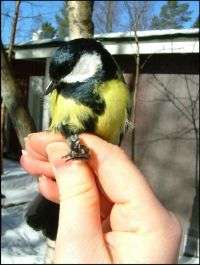
Researchers observed how a butterfly evolves to protect themselves from predators, such as the Great-tit.

Researchers observed the behaviour of Great-tits foraging for artificial prey to understand more clearly how a species evolves to protect themselves from predators.

Insects, such as butterflies, have bright contrasting colour patterns that indicate to predators that they are not likely to be palatable. In order to gain greater protection from predators, however, some butterflies evolve to imitate the warning signals of a more highly defended species – a phenomenon known as mimicry. Scientists at Liverpool, in collaboration with the University of Jyväskylä in Finland, tested which species of butterfly benefits the most from this technique.

Hannah Rowlands explains: “Previous studies have suggested that the relationship between two look-alike species is parasitic, whereby a ‘tastier’ insect reaps all the benefits of resembling a more unpalatable species. Scientists have argued that predators may get confused as to which species is most edible and which is not, resulting in them eating more of the unpalatable species than they normally would have done.

“We found that the two species of butterfly we used in our research do not undermine each other and benefit mutually from looking like each other. Copying in this sense is the highest form of flattery!”

In order to understand how this technique benefited both species of butterfly the team devised an experiment in an indoor aviary and observed the behaviour of Great-tits as they attacked artificial prey made from almond filled paper parcels.

Hannah added: “We coated some of the almonds in a non-toxic chemical which gave them a nasty taste, while others were moderately distasteful and some were left to taste simply of almonds. The birds in our aviary learnt to avoid the highly distasteful species quicker than the moderately distasteful ones. The ‘tastier’ species still benefited, however, in that the birds eventually learnt that in order to stop mistakenly eating the distasteful prey, they must stop eating both species altogether.

“We can now apply this model to other insects that use mimicking techniques, giving us greater insight into why particular species evolve to resemble one another and change their behaviour.”

Source: University of Liverpool

Explore further: Honeybees trained in Croatia to find land mines

add to favorites email to friend print save as pdf

Related Stories

Gulf fritillary is back

Sep 24, 2009

(PhysOrg.com) -- A showy butterfly with bright orange-red wings and a 4-inch wingspan is back in the Sacramento metropolitan area after a four-decade absence and in the Davis area after 30 years.

Painting by numbers

Sep 29, 2006

Professor Richard ffrench-Constant of the University of Exeter in Cornwall has worked with an international team of experts to ‘decode’ the patterns on butterflies’ wings.

Recommended for you

Honeybees trained in Croatia to find land mines

12 hours ago

(AP)—Mirjana Filipovic is still haunted by the land mine blast that killed her boyfriend and blew off her left leg while on a fishing trip nearly a decade ago. It happened in a field that was supposedly ...

Front-row seats to climate change

May 17, 2013

By day, insects provide the white noise of the South, but the night belongs to the amphibians. In a typical year, the Southern air hangs heavy from the humidity and the sounds of wildlife.

Climate change may have little impact on tropical lizards

May 17, 2013

A new Dartmouth College study finds human-caused climate change may have little impact on many species of tropical lizards, contradicting a host of recent studies that predict their widespread extinction in a rapidly warming ...

Wetlands: value to locals matters most

May 17, 2013

A new way of valuing ecosystem services, incorporating the local perspective, is the driving force behind a project assessing aquatic ecosystems in highland areas of Asia

User comments : 0

More news stories

Honeybees trained in Croatia to find land mines

(AP)—Mirjana Filipovic is still haunted by the land mine blast that killed her boyfriend and blew off her left leg while on a fishing trip nearly a decade ago. It happened in a field that was supposedly ...

Heat-related deaths in Manhattan projected to rise

Residents of Manhattan will not just sweat harder from rising temperatures in the future, says a new study; many may die. Researchers say deaths linked to warming climate may rise some 20 percent by the 2020s, ...

Kinks and curves at the nanoscale

One of the basic principles of nanotechnology is that when you make things extremely small—one nanometer is about five atoms wide, 100,000 times smaller than the diameter of a human hair—they are going ...